
Few experiences are as devastating to a relationship as betrayal. In a single moment, the safety, security, and confidence that once defined your relationship can seem to disappear. Whether the betrayal came through infidelity, emotional unfaithfulness, repeated lies, financial deception, broken promises, hidden addictions, or another serious breach of trust, the emotional impact can leave both partners questioning everything they once believed about each other. The relationship that once felt like home suddenly feels unfamiliar, and the future you imagined together can appear uncertain.
If you are reading this, you may be asking difficult questions. Can trust ever be restored? Will I ever feel safe with my partner again? Is forgiveness enough to heal what has been broken? Can our marriage survive this? These are not signs of weakness. They are the honest questions of someone trying to make sense of deep emotional pain. Betrayal affects more than your relationship. It often shakes your confidence, your emotional stability, your sense of security, and even your ability to trust your own judgment.
Many people assume that rebuilding trust simply requires an apology and time. Unfortunately, it is rarely that simple. Trust is not restored because someone says, “I’m sorry.” Neither does it automatically return because the affair ended or the secret was finally exposed. Genuine trust is rebuilt through consistent actions, intentional healing, accountability, and the willingness of both partners to engage in the difficult work of restoration. While forgiveness may happen in a moment, rebuilding trust is almost always a process.
The good news is that betrayal does not have to be the final chapter of your relationship. Although not every relationship survives betrayal, many couples have emerged stronger, wiser, and more deeply connected because they chose to heal intentionally rather than merely move on. In many cases, the rebuilding process exposes unhealthy patterns that existed long before the betrayal, creating an opportunity to establish a healthier, stronger, and more resilient marriage than the one that existed before the crisis.
As the Family Life Doctor, I have walked alongside couples navigating some of the darkest moments in their relationships. One truth has become increasingly clear: healing is possible when both partners are committed to honesty, accountability, and growth. My approach combines timeless Christian principles with research based relationship strategies because lasting restoration requires both spiritual transformation and practical action. Strong marriages are not built on perfect people. They are built by imperfect people who consistently choose truth, humility, grace, and intentional love.
In this comprehensive guide, you will discover why betrayal hurts so deeply, whether trust can truly be rebuilt, the stages every couple goes through during recovery, practical steps that restore emotional safety, common mistakes that slow healing, and how faith can become a powerful foundation for rebuilding your relationship. Whether you are the one who was betrayed or the one seeking forgiveness after causing deep hurt, this guide will provide a clear roadmap toward healing.
Your relationship may never return to what it once was, and perhaps that should not be your goal. Instead, the goal is to build something stronger: a relationship marked by greater honesty, deeper emotional intimacy, renewed trust, and a shared commitment to protecting what matters most. Healing begins with understanding, and rebuilding trust begins with taking the next intentional step.
Understanding Betrayal and Why Trust Breaks So Deeply
Trust is the invisible foundation of every healthy relationship. It is what allows two people to be emotionally vulnerable, make long term commitments, share their deepest fears, and believe that the other person has their best interests at heart. When trust exists, love feels secure. Conversations feel safe. Conflicts become easier to navigate because both partners believe they are on the same team.
Betrayal changes all of that.
The moment trust is broken, the relationship is no longer experienced in the same way. What once felt predictable becomes uncertain. The person who was once your greatest source of comfort may suddenly become the source of your deepest pain. This emotional shift explains why betrayal is often described as one of the most painful experiences a person can endure within a relationship.
What Is Betrayal in a Relationship?
Betrayal occurs when one partner violates the expectations, commitments, or boundaries that form the foundation of the relationship. At its core, betrayal is not simply about what happened. It is about the loss of emotional safety that follows.
Many people immediately think of infidelity when they hear the word betrayal, but trust can be broken in many different ways. In fact, some forms of betrayal leave wounds that are just as deep as a physical affair because they involve repeated deception and hidden behavior.
Some of the most common forms of betrayal include:
- Sexual infidelity or extramarital affairs
- Emotional affairs that create intimacy outside the marriage
- Repeated lying or withholding important information
- Financial infidelity, such as hiding debts, secret spending, or undisclosed bank accounts
- Pornography addiction kept secret from a spouse
- Hidden addictions involving gambling, alcohol, or drugs
- Breaking significant promises repeatedly
- Violating agreed relationship boundaries
- Public humiliation or consistent disrespect
- Emotional abandonment through neglect or chronic unavailability
Although these situations differ, they all have one thing in common: they communicate to the injured partner that the relationship was not protected in the way they believed it would be.
Why Betrayal Hurts More Than Most People Realize
Many people assume the pain comes solely from the act itself. In reality, the greatest damage often comes from what the betrayal represents.
When trust is broken, people begin questioning not only the present but also the past.
They wonder: “Was any of it real?” “How long has this been happening?” “What else don’t I know?” “Can I ever believe another word they say?” These questions reveal that betrayal attacks the very foundation upon which the relationship was built.
Betrayal Destroys Emotional Safety
Healthy relationships thrive because both partners believe they are emotionally safe with one another. Emotional safety means knowing that your vulnerability will not be exploited, your confidence will not be violated, and your heart will be treated with care. Betrayal shatters that confidence.
The injured partner often becomes emotionally guarded because the person they trusted most has become the person they fear most. Conversations become filtered. Affection becomes cautious. Even ordinary moments can trigger anxiety because safety no longer feels guaranteed.
Betrayal Creates an Identity Crisis
Many people underestimate how deeply betrayal affects a person’s sense of self. A betrayed spouse may begin asking questions like:
- Was I not enough?
- Did I miss obvious warning signs?
- Can I trust my own judgment?
- Am I unlovable?
- Will this happen again?
These questions reveal that betrayal often damages self esteem as much as it damages the relationship. The injured partner is not simply grieving the loss of trust. They are also grieving the version of reality they believed existed.
Betrayal Changes the Brain’s Sense of Security
When trust is broken, the brain shifts into self protection mode. Instead of feeling relaxed within the relationship, it becomes constantly alert for signs of further danger.
This explains why someone recovering from betrayal may repeatedly revisit the details of what happened, ask the same questions many times, or struggle to believe reassuring words. Their brain is not trying to create conflict. It is trying to determine whether it is safe to trust again.
As a result, many betrayed partners experience persistent emotional distress long after the betrayal has been discovered.
Common Signs of Betrayal Trauma
Every individual responds differently, but many people experience similar emotional and physical symptoms after betrayal.
These may include:
- Constant replaying of the betrayal in their mind
- Difficulty sleeping or frequent nightmares
- Anxiety, panic attacks, or racing thoughts
- Hypervigilance and constantly checking for signs of deception
- Sudden emotional outbursts or uncontrollable crying
- Difficulty concentrating at work or home
- Loss of appetite or emotional eating
- Emotional numbness or detachment
- Fear of intimacy or vulnerability
- Feeling isolated, ashamed, or deeply embarrassed
Some people describe betrayal as feeling like the ground beneath them has disappeared. Others compare it to grieving the death of the relationship they thought they had. These reactions are normal responses to a deeply painful emotional injury.
Why Time Alone Does Not Heal Broken Trust
One of the most common misconceptions is that trust naturally returns with time. Time certainly softens emotional intensity, but it does not automatically rebuild trust.
A couple can live together for years after betrayal and still feel emotionally distant if the underlying issues remain unresolved. Silence is not healing. Avoiding difficult conversations is not healing. Pretending everything is normal is not healing.
Trust is restored when honesty replaces secrecy, consistency replaces unpredictability, accountability replaces defensiveness, and emotional safety is rebuilt one decision at a time. Without intentional repair, the pain often goes underground rather than disappearing.
The First Step Toward Healing
If your relationship has experienced betrayal, it is important to remember that the intensity of your pain reflects the depth of your investment, not the weakness of your character. Trust was broken because you genuinely believed in your relationship. That belief deserves compassion, not shame.
Understanding what betrayal has done to your heart, your mind, and your relationship is the first step toward healing. Only when the wound is acknowledged can restoration truly begin.
Can Trust Really Be Rebuilt After Betrayal?
One of the first questions people ask after discovering betrayal is, “Can we ever get back to where we were?” It is an understandable question. When trust has been shattered, the future can feel uncertain, and the relationship may seem beyond repair. Some people assume that once trust is broken, it can never be restored. Others believe that a sincere apology should be enough to fix everything. The truth lies somewhere in between.
Yes, trust can be rebuilt after betrayal. Every year, thousands of couples recover from affairs, deception, broken promises, and other serious breaches of trust. They learn to communicate differently, reconnect emotionally, and build healthier marriages than they had before the betrayal occurred. However, not every relationship survives, and not every couple should reconcile. Rebuilding trust is possible, but it requires far more than hope or good intentions.
The question is not simply whether trust can be rebuilt. The more important question is whether both people are willing to do what rebuilding trust demands.
What Determines Whether Trust Can Be Restored?
The outcome of a relationship after betrayal is rarely determined by the betrayal itself. More often, it is determined by how both partners respond after the truth comes to light.
Healing becomes much more likely when certain conditions are present.
Genuine Remorse Instead of Mere Regret
There is an important difference between regret and remorse. Regret focuses on the consequences of getting caught. A remorseful person focuses on the pain they have caused. They do not make excuses, minimize their actions, or shift blame onto their spouse. Instead, they take full ownership of the damage they have created and demonstrate a sincere desire to make things right.
True remorse is visible in changed behavior, not just emotional words.
Complete Honesty
Trust cannot be rebuilt on partial truths. One of the most damaging mistakes after betrayal is what therapists often call “trickle truth,” where new pieces of information continue to emerge over time. Every new discovery reopens old wounds and convinces the injured partner that the deception is still continuing.
Rebuilding trust requires complete honesty from the beginning. While difficult conversations may temporarily increase pain, hidden information almost always prolongs it.
Consistent Accountability
Promises alone do not restore confidence. The betrayed partner needs evidence that genuine change is taking place. Accountability means willingly accepting responsibility for actions, answering difficult questions with patience, remaining transparent, and understanding that rebuilding trust takes time.
Accountability is not punishment. It is proof that the relationship matters enough to protect moving forward.
A Shared Commitment to Healing
Although one person may have caused the betrayal, rebuilding the relationship eventually becomes a shared responsibility.
The partner who caused the hurt must focus on rebuilding safety through honesty, consistency, and empathy. The injured partner must also be willing, when emotionally ready, to engage in the healing process rather than remaining permanently trapped in resentment or emotional withdrawal.
This does not mean both partners share equal responsibility for the betrayal itself. They do not. However, rebuilding a healthy marriage requires both people to participate in creating a healthier future.
Patience With the Process
Many couples become discouraged because healing takes longer than they expected.
Trust is not rebuilt in a few weeks. Emotional wounds heal gradually through repeated experiences of safety, honesty, and reliability. There will be difficult conversations, emotional setbacks, and moments when progress feels painfully slow.
This does not mean healing is failing. It simply means healing is unfolding.
Couples who remain committed to the process often discover that consistency, rather than speed, produces lasting restoration.
Forgiveness, Reconciliation, and Trust Are Not the Same Thing
One of the greatest sources of confusion after betrayal is treating forgiveness, reconciliation, and trust as though they mean the same thing. They do not.
Understanding the difference helps couples avoid unrealistic expectations.
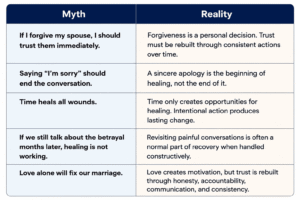
Perhaps the most important distinction is this: forgiveness is given, but trust is earned.
A spouse may genuinely forgive while still needing time before they feel emotionally safe again. That does not mean forgiveness is incomplete. It means wisdom is allowing trust to grow at the pace that consistent change permits.
Rebuilding Trust Is About Creating a New Relationship
Many couples begin recovery hoping to return to the relationship they had before the betrayal.
Ironically, that is often the wrong goal. The relationship that existed before the betrayal may have contained unhealthy communication patterns, emotional distance, unresolved conflicts, weak boundaries, or unmet needs that went unaddressed for years. While none of these issues excuse betrayal, they often reveal opportunities for growth that existed long before trust was broken.
The healthiest couples do not simply rebuild the old relationship. They intentionally create a new one, one marked by greater honesty, deeper emotional intimacy, stronger boundaries, healthier communication, and a renewed commitment to protecting each other’s hearts.
This is why many couples who successfully navigate betrayal describe their restored marriage as different rather than identical. The pain of betrayal becomes the catalyst for building something stronger, wiser, and more intentional than what existed before.
The 6 Stages of Rebuilding Trust After Betrayal
Rebuilding trust after betrayal is not a single decision. It is a journey. Many couples become discouraged because they expect healing to happen in a straight line. They assume that after an apology, a few heartfelt conversations, and some time, everything should return to normal.
That is rarely how healing works.
Recovery often feels like taking two steps forward and one step back. Some days bring hope and renewed connection, while others reopen old wounds and painful memories. This does not mean the relationship is failing. It simply means healing is a process rather than an event.
Although every couple’s journey is unique, most successful recoveries follow six distinct stages. Understanding these stages can help you recognize where you are, manage realistic expectations, and avoid giving up too soon.
Stage 1: The Truth Comes Into the Light
Every healing journey begins with honesty. Whether the betrayal was uncovered unexpectedly or confessed voluntarily, trust cannot begin to recover until the full truth is revealed. This stage is often the most emotionally overwhelming because it forces both partners to confront a painful reality they may have spent months or even years avoiding.
For the betrayed partner, this stage often brings shock, anger, grief, confusion, and countless unanswered questions. For the partner who caused the betrayal, it may bring guilt, fear, shame, and anxiety about the future of the relationship.
One of the biggest mistakes couples make during this stage is allowing the truth to emerge gradually. Sometimes called “trickle truth,” this happens when small pieces of information continue to surface over time. Every new revelation creates another wave of pain and convinces the injured partner that the deception has not truly ended.
Healing begins when honesty is complete. This means resisting the temptation to minimize what happened, hide uncomfortable details, or blame external circumstances. Genuine restoration requires full transparency, even when the truth is difficult to hear.
At this stage, the goal is not to solve every problem. The goal is to establish a foundation of truth upon which healing can be built.
Stage 2: Creating Emotional Safety
Once the truth has been revealed, emotions often become intense. The betrayed partner may experience anger one moment and deep sadness the next. They may ask the same questions repeatedly or struggle to understand how someone they trusted could hurt them so deeply. Meanwhile, the partner who caused the betrayal may become defensive, impatient, or overwhelmed by shame.
This stage requires creating emotional safety before attempting to rebuild emotional intimacy.
Emotional safety means both partners can express difficult emotions without fear of ridicule, manipulation, or emotional abandonment. For the betrayed spouse, this means having space to grieve honestly.
For the offending spouse, it means learning to listen without becoming defensive or making the conversation about their own discomfort.
Creating emotional safety includes:
- Allowing honest conversations without interruption.
- Listening with empathy rather than arguing.
- Validating the injured partner’s pain instead of minimizing it.
- Avoiding threats of separation during every disagreement.
- Remaining emotionally available even when conversations become uncomfortable.
Without emotional safety, trust cannot grow because vulnerability never feels secure.
Stage 3: Taking Full Responsibility
Healing accelerates when accountability replaces excuses. At this stage, the partner responsible for the betrayal must move beyond simply admitting what happened and begin taking ownership of its impact.
True accountability sounds like: “I hurt you.” “My choices damaged our relationship.” “You did not deserve this.” “I understand why rebuilding trust will take time.”
It does not sound like: “If you had paid more attention to me…” “Everyone makes mistakes.” “You should be over this by now.” “Let’s stop talking about the past.”
Blame shifting delays healing because it communicates that the injured partner’s pain is an inconvenience rather than a consequence of the betrayal.
Taking responsibility also involves accepting that rebuilding trust requires consistent effort over an extended period. The partner who caused the betrayal must become willing to answer difficult questions, maintain transparency, and demonstrate trustworthy behavior repeatedly without becoming resentful.
Accountability is not about punishment. It is about rebuilding confidence through consistent integrity.
Stage 4: Repairing Communication
Betrayal damages communication almost as much as it damages trust. Simple conversations become emotionally charged because every discussion is influenced by fear, suspicion, guilt, or unresolved pain. Misunderstandings increase, defensiveness becomes common, and many couples begin avoiding meaningful conversations altogether.
This stage focuses on learning a healthier way to communicate.
Healthy communication after betrayal requires replacing accusation with curiosity, defensiveness with empathy, and assumptions with honest dialogue.
Both partners must learn to:
- Listen before responding.
- Express emotions without attacking each other.
- Ask questions to understand rather than to win arguments.
- Validate feelings even when perspectives differ.
- Speak truthfully with kindness and respect.
One of the most powerful skills couples can develop during this stage is active listening. Instead of preparing a defense while the other person speaks, each partner learns to genuinely hear and acknowledge what the other is experiencing.
Healing conversations are rarely perfect, but they become opportunities to rebuild connection rather than create further division.
Stage 5: Rebuilding Trust Through Consistent Actions
Trust is not restored through promises, It is restored through patterns.
At this stage, words become less important than daily behavior. The betrayed partner begins watching for evidence that genuine change is taking place.
Consistency becomes the new language of trust.
This may include:
- Being honest even about small matters.
- Keeping commitments consistently.
- Following through on promises.
- Remaining transparent with phones, finances, and schedules when appropriate.
- Demonstrating emotional availability.
- Respecting agreed boundaries.
- Showing patience during difficult moments.
These seemingly ordinary actions gradually create extraordinary results. Each consistent decision becomes another brick in rebuilding the foundation of trust. Over time, repeated experiences of honesty begin replacing repeated memories of deception.
This stage often requires the greatest patience because trust grows slowly. However, lasting trust has always been built through repeated reliability rather than dramatic gestures.
Stage 6: Building a Stronger Relationship Than Before
The final stage is not about returning to the relationship that existed before the betrayal.
It is about creating a healthier one. Many couples discover that, while they would never choose the pain of betrayal, the recovery journey forced them to address issues they had ignored for years. They learned healthier communication skills, developed greater emotional intimacy, strengthened their spiritual connection, and established clearer boundaries.
This stage focuses on building a shared future rather than remaining trapped in the past.
Couples begin discussing questions such as:
- What kind of marriage do we want moving forward?
- How can we protect our relationship from future threats?
- What habits strengthen our emotional connection?
- How do we continue growing individually and together?
Instead of simply avoiding another betrayal, the relationship becomes intentionally designed around honesty, trust, friendship, emotional intimacy, and shared purpose.
For couples of faith, this stage often includes renewed spiritual practices such as praying together, studying Scripture, serving together, and seeking ongoing accountability within a trusted community.
The goal is not merely survival, the goal is transformation.
Healing Is a Journey, Not a Destination
These six stages are not rigid checkpoints that every couple completes in perfect order. You may revisit earlier stages, especially after emotional triggers or difficult conversations. Some couples move through them quickly, while others require months or even years of intentional work.
Progress should not be measured by how quickly pain disappears but by how consistently trust is being rebuilt.
Every honest conversation, every fulfilled promise, every act of accountability, and every moment of emotional safety moves the relationship one step closer to restoration.
12 Practical Steps That Actually Rebuild Trust After Betrayal
After betrayal, many couples ask the same question: “What do we do now?” They know the relationship cannot continue as if nothing happened, but they are unsure how to move from pain to healing.
The answer is both simple and challenging. Trust is rebuilt through consistent, intentional actions repeated over time.
There is no single conversation, grand romantic gesture, or emotional breakthrough that instantly restores confidence. Instead, healing happens through hundreds of small decisions that gradually convince the injured partner that the relationship is becoming safe again.
The following twelve steps have helped countless couples move from brokenness toward restoration. While every relationship is different, these principles provide a practical roadmap for rebuilding trust in a healthy and lasting way.
1. Tell the Whole Truth
Trust cannot grow where deception still exists. One of the greatest mistakes after betrayal is revealing information little by little. Every new discovery feels like another betrayal because it reminds the injured partner that honesty is still incomplete.
If there are hidden details that will inevitably surface later, it is far better to address them now than to allow them to emerge months later.
Complete honesty is painful in the short term, but incomplete honesty prolongs the healing process.
Common mistake:
Sharing only enough information to reduce personal consequences.
Action step:
Commit to complete honesty moving forward, even when the truth is uncomfortable.
2. Cut Off Every Source of Betrayal Completely
Healing cannot begin while betrayal continues. Whether the issue involved an affair, emotional attachment, secret messaging, pornography, financial dishonesty, or other hidden behavior, there must be a clear and permanent break from whatever violated the relationship.
Leaving room for continued contact or secret communication sends the message that the relationship is still competing with the betrayal. True repentance removes opportunities for repeated failure.
Common mistake:
Maintaining “just friendship” with someone who was part of the betrayal.
Action step:
Create firm boundaries that demonstrate your commitment to protecting your marriage above every other relationship.
3. Practice Radical Transparency
After betrayal, privacy and secrecy are no longer viewed the same way. Transparency is not about living under surveillance forever. It is about willingly providing reassurance while trust is being rebuilt.
This may include openness about schedules, finances, passwords, phone use, or social interactions where appropriate and mutually agreed upon.
Transparency communicates, “I have nothing to hide because I am committed to rebuilding your confidence.”
Over time, transparency becomes less about monitoring and more about restoring peace.
Common mistake:
Becoming defensive when asked reasonable questions.
Action step:
Choose openness before your partner has to ask.
4. Let Actions Speak Louder Than Words
After betrayal, promises lose much of their power. The injured partner has heard reassuring words before. What they now need is consistent evidence that change is real; every kept promise matters, arriving home when you said you would, following through on commitments, being emotionally available, remaining honest about small matters. These ordinary acts become extraordinary because they slowly rebuild confidence.
Remember this principle: Trust grows when actions consistently match words.
Common mistake:
Expecting verbal apologies to carry more weight than daily behavior.
Action step:
Focus less on convincing your partner and more on becoming consistently trustworthy.
5. Give Your Partner Permission to Heal at Their Own Pace
Healing cannot be rushed. One partner may be ready to move forward while the other is still processing grief, anger, and confusion. This difference does not mean someone is refusing to heal.
Recovery after betrayal is deeply personal, some days your spouse may seem hopeful, other days they may feel overwhelmed by memories. Patience is one of the greatest gifts you can offer during this season.
Avoid statements such as: “Why are we still talking about this?” “I thought you forgave me.” “You’re making this harder than it needs to be.” Healing does not follow a calendar.
Common mistake:
Measuring recovery by how quickly painful conversations stop.
Action step:
Respond to emotional setbacks with empathy rather than frustration.
6. Take Responsibility Without Becoming Defensive
Defensiveness slows healing because it shifts attention away from the injured person’s pain. Accountability means acknowledging both the behavior and its consequences. Healthy accountability sounds like: “I understand why this still hurts.” “You deserved better.” “I am committed to earning your trust again.”
Notice that none of these statements contain excuses, owning your choices creates emotional safety because it shows maturity and integrity.
Common mistake:
Explaining instead of accepting responsibility.
Action step:
Practice responding with empathy before offering explanations.
7. Establish Healthy Boundaries Together
Trust flourishes inside healthy boundaries. Following betrayal, couples should intentionally discuss the boundaries that will protect their relationship moving forward.
These boundaries may include:
- Appropriate friendships with the opposite sex.
- Social media expectations.
- Financial transparency.
- Travel arrangements.
- Work relationships.
- Digital communication habits.
- Accountability structures.
Boundaries are not signs of distrust, they are expressions of wisdom. Strong marriages protect what they value most.
Common mistake:
Viewing boundaries as restrictions instead of protection.
Action step:
Create written relationship boundaries together and review them regularly.
8. Learn to Communicate About Pain Without Creating More Pain
Many couples either avoid difficult conversations or turn every discussion into an argument. Neither approach promotes healing. Healthy communication means discussing painful experiences with honesty, respect, and emotional maturity.
- Instead of attacking character, describe feelings.
- Instead of assuming motives, ask questions.
- Instead of trying to win arguments, seek understanding.
- Healing conversations build bridges instead of walls.
Common mistake:
Allowing every discussion to become a courtroom where someone must win.
Action step:
Schedule intentional conversations where both partners can speak and listen without interruption.
9. Rebuild Emotional Intimacy Before Expecting Physical Intimacy
After betrayal, emotional safety almost always comes before physical closeness. The injured partner often needs reassurance that they are emotionally valued before they can comfortably reconnect physically.
Rebuilding emotional intimacy involves:
- Spending intentional time together.
- Having meaningful conversations.
- Showing affection without pressure.
- Expressing appreciation daily.
- Sharing hopes, fears, and dreams again.
When emotional connection deepens, physical intimacy often becomes a natural extension rather than an obligation.
Common mistake:
Using physical intimacy to avoid addressing emotional wounds.
Action step:
Prioritize emotional closeness through daily connection rituals.
10. Address the Root Cause, Not Just the Betrayal
Betrayal is a behavior, healthy recovery explores what allowed that behavior to develop without excusing it. This requires honest self reflection.
Questions worth asking include:
- What unhealthy beliefs influenced my decisions?
- How did I justify crossing boundaries?
- What emotional patterns need to change?
- Where do I need personal growth?
The goal is not simply preventing another affair or lie, the goal is becoming a healthier individual capable of sustaining a healthier marriage.
Common mistake:
Focusing only on external behavior without addressing internal character.
Action step:
Commit to personal growth alongside relationship restoration.
11. Invite Trusted Support Into Your Healing Journey
Many couples try to rebuild trust entirely on their own, unfortunately, isolation often prolongs pain. Healing becomes healthier when couples receive wise guidance from trusted professionals, mature mentors, pastors, or marriage coaches who can provide objective support.
Seeking help is not an admission of failure, it is evidence that your relationship is worth fighting for. As Proverbs 15:22 reminds us: “Plans fail for lack of counsel, but with many advisers they succeed.”
Professional support like our Affairs recovery coaching can provide practical tools, facilitate difficult conversations, and help couples avoid patterns that keep them stuck.
Common mistake:
Waiting until the relationship is falling apart before seeking help.
Action step:
Invest in marriage coaching or counseling early rather than treating it as a last resort.
12. Commit to Lifelong Growth, Not Temporary Change
The ultimate goal is not simply surviving betrayal. It is becoming the kind of couple who continually invests in the health of their relationship.
Trust continues growing long after the crisis has passed. Healthy couples intentionally build habits that strengthen connection, including:
- Regular marriage check ins.
- Shared spiritual practices.
- Continuous learning.
- Open communication.
- Intentional date nights.
- Celebrating progress.
- Addressing conflict early.
The strongest marriages are not those without problems, they are the ones where both partners remain committed to growing together.
Common mistake:
Returning to old habits once the crisis feels over.
Action step:
Develop ongoing relationship habits that make trust stronger every year.
Trust Is Rebuilt One Decision at a Time
There is no shortcut to rebuilding trust after betrayal.
It is earned through honesty when lying would be easier, consistency when excuses would be more convenient, humility when pride wants to defend itself, and love expressed through daily actions rather than occasional words.
The encouraging news is that every healthy choice moves your relationship forward. Every honest conversation, every fulfilled commitment, every act of transparency, and every moment of empathy becomes another brick in rebuilding a foundation that once seemed beyond repair.
6 Mistakes That Destroy Trust All Over Again
After betrayal, most couples genuinely want to heal. They apologize, have difficult conversations, and promise to do better. Yet many relationships remain stuck, not because healing is impossible, but because they unknowingly repeat behaviors that reopen old wounds.
Rebuilding trust is not only about doing the right things. It is also about avoiding the wrong ones.
Some mistakes seem harmless on the surface but quietly undermine progress, leaving the betrayed partner feeling unsafe all over again. Recognizing these pitfalls can help you protect the healing process and avoid unnecessary setbacks.
1. Expecting Trust to Return Too Quickly
One of the most common mistakes is assuming that because the betrayal has ended, the pain should end too. The partner who caused the betrayal may think, “I’ve apologized. I’m being faithful now. Why can’t we just move on?”
Unfortunately, trust does not recover at the same speed as behavior changes.
The injured partner is trying to rebuild a sense of emotional safety that was deeply shaken. That takes time, consistency, and patience.
Healing cannot be rushed without creating additional pressure and frustration.
2. Becoming Defensive During Difficult Conversations
Few things damage trust more than defensiveness. When the betrayed partner expresses pain, the natural temptation may be to explain, justify, or protect yourself. However, defensiveness often communicates that protecting your image is more important than understanding your spouse’s experience.
Instead of saying, “You’re overreacting.” or “You’re bringing this up again?”
respond with empathy, “I understand why this still hurts.” “I’m listening.” “Tell me what you’re feeling.”
Healing conversations begin with understanding, not self protection.
3. Minimizing the Pain
Statements such as, “It wasn’t that serious.” “Nothing physical happened.” “You’re making it bigger than it was.” may feel like attempts to calm the situation, but they often deepen the hurt.
The impact of betrayal is determined by the person who experienced it, not the person who caused it. Minimizing your partner’s pain communicates that their emotional experience is invalid.
Validation does not require agreeing with every emotion. It requires acknowledging that those emotions are real.
4. Keeping New Secrets to Avoid Conflict
After betrayal, even small acts of secrecy can trigger enormous fear. You may think, “I didn’t mention it because I didn’t want another argument.”
Unfortunately, hidden information often creates more damage than the information itself, because trust grows through transparency. Even when the truth is uncomfortable, openness creates safety while secrecy recreates suspicion.
Remember, rebuilding trust means choosing honesty even when dishonesty seems easier.
5. Using Forgiveness to End the Conversation
Forgiveness is beautiful, but weaponizing forgiveness is not. Sometimes the partner who caused the betrayal says things like, “Didn’t you already forgive me?” or “If you’ve forgiven me, why are we still talking about this?” These statements confuse forgiveness with healing.
A person can genuinely forgive while still processing grief, asking questions, or rebuilding emotional safety. Healing often requires many conversations before the pain gradually loses its intensity because patience is part of love.
6. Ignoring the Root Causes
Many couples focus entirely on the betrayal itself without exploring what allowed it to happen and this is dangerous.
Although nothing justifies betrayal, lasting recovery requires honest reflection about unhealthy beliefs, poor boundaries, emotional immaturity, unresolved personal struggles, or destructive relationship patterns.
If only the symptoms are addressed, the underlying problems often remain. Healing becomes deeper when both partners pursue personal growth alongside relationship restoration.
Are You Accidentally Slowing Down Your Healing?
Use this simple checklist to evaluate whether your recovery is moving in the right direction.
Healthy Recovery Checklist
☐ We are completely honest with each other, even when the truth is uncomfortable.
☐ We listen to understand instead of becoming defensive.
☐ We allow space for difficult emotions without rushing the healing process.
☐ We have established healthy boundaries that protect our relationship.
☐ We communicate openly instead of avoiding difficult conversations.
☐ We focus on consistent actions rather than empty promises.
☐ We are addressing the deeper issues that contributed to the betrayal.
☐ We are investing in both personal growth and relationship growth.
☐ We are willing to seek help when we need guidance.
☐ We are intentionally building a healthier marriage instead of simply trying to forget the past.
The more statements you can honestly check, the stronger your foundation for rebuilding trust is becoming.
How Faith, Grace, and Forgiveness Fit Into Rebuilding Trust
For many Christian couples, betrayal raises difficult spiritual questions alongside emotional ones. If God commands me to forgive, does that mean I have to trust again immediately? Does choosing to stay mean pretending the betrayal never happened? If grace covers sin, should accountability still matter?
These questions deserve thoughtful answers because misunderstanding biblical forgiveness can unintentionally create more pain instead of promoting healing.
The Bible offers tremendous hope for broken relationships, but it never encourages denial, enables repeated sin, or dismisses the importance of wisdom. Throughout Scripture, we see a consistent pattern: grace and truth always work together. God extends mercy, but He also calls people to repentance, transformation, and restored integrity.
When rebuilding trust after betrayal, faith does not replace practical work. Rather, it strengthens and guides it.
Forgiveness Is a Command, but Trust Is Earned
One of the biggest misconceptions among Christian couples is believing that forgiveness and trust are the same thing, well, they are not.
Forgiveness is a decision to release the desire for revenge and entrust justice to God. It is an act of obedience that frees your heart from bitterness and creates space for healing.
Trust, however, is confidence in another person’s reliability. While forgiveness can happen in a moment, trust develops over time through consistent honesty, accountability, and changed behavior.
Jesus repeatedly taught forgiveness, yet He also demonstrated wisdom in whom He entrusted Himself to. Scripture never suggests that forgiving someone requires ignoring patterns of unhealthy behavior or abandoning healthy boundaries.
You can forgive someone while still requiring evidence of genuine transformation, that is not unforgiveness, it is wisdom.
Grace Does Not Eliminate Accountability
Grace is often misunderstood as overlooking wrongdoing. Biblically, grace does something far greater. Grace offers the opportunity for restoration while calling people toward genuine change.
When King David committed adultery with Bathsheba and arranged the death of her husband, God forgave him after he repented sincerely. Yet David still experienced painful consequences for his choices. His forgiveness did not remove accountability.
This reminds us of an important truth; God’s mercy is abundant, but repentance always produces visible change.
Likewise, in marriage, genuine repentance involves more than saying, “I’m sorry.”
It includes:
- Taking full responsibility without making excuses.
- Demonstrating consistent honesty.
- Accepting healthy accountability.
- Making practical changes that rebuild safety.
- Remaining patient throughout the healing process.
Grace creates the opportunity for restoration, while repentance creates the pathway toward rebuilding trust.
Repentance Is More Than Feeling Sorry
The Bible distinguishes between feeling guilty and experiencing genuine repentance. Guilt focuses on feeling bad, while repentance focuses on becoming different.
Someone may cry after being caught but continue repeating the same unhealthy patterns, that is regret. Repentance produces lasting transformation.
In the context of rebuilding trust, genuine repentance can be recognized through observable behaviors:
- Increased transparency.
- Greater humility.
- Consistent honesty.
- Willingness to answer difficult questions.
- A desire to protect the relationship rather than protect personal reputation.
Real repentance gives the betrayed spouse confidence that the future does not have to look like the past.
Healthy Boundaries Reflect Biblical Wisdom
Some Christians struggle with setting boundaries because they fear it appears unforgiving. The opposite is often true, healthy boundaries honor both love and wisdom.
Throughout Scripture, wisdom teaches us to guard what God has entrusted to us. A healthy marriage requires intentional protection from temptation, secrecy, and unhealthy influences.
After betrayal, boundaries may include:
- Greater transparency with communication.
- Clear expectations regarding friendships.
- Financial openness.
- Accountability relationships.
- Guarding emotional intimacy outside the marriage.
- Protecting time for the relationship.
Boundaries are not walls designed to keep people apart, they are guardrails designed to keep the relationship safe.
God Specializes in Restoration
One of the greatest messages of the Gospel is that God restores broken things. Throughout Scripture, we see people who failed deeply yet experienced redemption through repentance and God’s grace.
Peter denied Jesus three times, yet Jesus lovingly restored him and entrusted him with leadership.
The Prodigal Son squandered his inheritance, yet the Father welcomed him home with compassion after genuine repentance.
Joseph was betrayed by his brothers, rather than allowing bitterness to define his future, God used his pain to accomplish a greater purpose.
These stories remind us that failure does not have to be the end of the story. However, every story of restoration includes humility, repentance, transformation, and God’s ongoing work in people’s hearts. Restoration was never automatic, it was intentional.
Invite God Into the Healing Process
While rebuilding trust requires practical action, lasting healing also requires spiritual renewal. Couples who intentionally invite God into their recovery often discover strength that goes beyond their own emotional capacity.
Some practical ways to strengthen your spiritual foundation include:
- Pray together consistently, even when conversations feel difficult.
- Read and reflect on Scripture that emphasizes grace, wisdom, and restoration.
- Worship together and remain connected to your local church community.
- Seek counsel from spiritually mature mentors or Christian marriage coaches.
- Ask trusted believers to provide ongoing encouragement and accountability.
- Pray not only for your marriage but also for each other’s personal transformation.
Healing is not simply about saving a relationship, it is about allowing God to shape two individuals into people who reflect His character more faithfully.
Frequently Asked Questions About Rebuilding Trust After Betrayal
When a relationship has been shaken by betrayal, questions often feel endless. You may wonder whether your emotions are normal, whether your marriage can truly recover, or whether trusting again is even wise.
Below are answers to some of the most common questions couples ask during the healing process. While every relationship is unique, these principles can help you navigate the journey with greater clarity and confidence.
How Long Does It Take to Rebuild Trust After Betrayal?
There is no universal timeline for rebuilding trust. For some couples, noticeable progress begins within several months. For others, especially where the betrayal was prolonged or repeated, the healing process may take one to three years or even longer.
The timeline depends on several factors, including:
- The nature and severity of the betrayal.
- Whether the truth was fully disclosed.
- The level of genuine remorse shown.
- Consistency in rebuilding trust.
- The emotional health of both partners.
- Whether professional support is involved.
Rather than asking, “How long will this take?” ask, “Are we making steady progress?”
Healing is measured by growing honesty, emotional safety, and consistency, not simply by the passage of time.
Can a Marriage Really Survive Betrayal?
Yes, many marriages do survive betrayal.
In fact, some couples develop stronger communication, deeper emotional intimacy, and healthier relationship habits because they intentionally addressed issues that had been ignored for years. However, survival is not automatic.
A marriage has a much greater chance of recovering when:
- The partner responsible takes full responsibility.
- Both spouses commit to rebuilding the relationship.
- Transparency replaces secrecy.
- Healthy boundaries are established.
- Professional guidance is sought when needed.
Betrayal may become part of your story, but it does not have to define the rest of your marriage.
Will I Ever Trust My Spouse Again?
Yes, but trust may look different than it did before. Healthy trust after betrayal is usually built more intentionally. Instead of assuming trust, couples learn to create it through honesty, accountability, communication, and consistency.
Over time, repeated trustworthy behavior gradually replaces memories of deception. Trust is rarely restored in one dramatic moment, it grows through hundreds of ordinary decisions made faithfully over time.
Should I Forgive Someone Who Is Not Sorry?
Forgiveness and reconciliation are not the same. You can choose to forgive because it frees your heart from bitterness and places justice in God’s hands.
However, reconciliation requires something more, it requires genuine repentance, accountability, and a willingness to rebuild trust.
If someone refuses to acknowledge wrongdoing or continues harmful behavior, forgiveness does not require you to ignore wisdom or remain in an unhealthy situation. Biblical forgiveness is always compatible with healthy boundaries.
Can Trust Be Rebuilt After Repeated Lies?
Yes, but rebuilding trust after repeated deception is often more challenging because repeated lies create deeper patterns of insecurity.
In these situations, change must be demonstrated consistently over an extended period.
The partner responsible will usually need to show:
- Complete honesty.
- Radical transparency.
- Patience during difficult conversations.
- Consistent follow through.
- Willingness to remain accountable.
Repeated deception requires repeated evidence of transformation before trust can grow again.
Is Emotional Cheating as Harmful as Physical Infidelity?
Emotional affairs can be just as devastating as physical affairs. When emotional intimacy, vulnerability, affection, or romantic attachment is directed toward someone outside the marriage, the betrayed spouse often experiences the same feelings of rejection, insecurity, and broken trust.
Many people say what hurt them most was not physical intimacy but the secrecy, emotional investment, and deception involved. Healthy marriages protect both emotional and physical faithfulness.
What If My Spouse Refuses Marriage Counseling?
You cannot force another person to seek help. However, you can continue pursuing your own healing.
Individual coaching or counseling can help you:
- Process your emotions.
- Develop healthy boundaries.
- Improve your communication.
- Make wise decisions about your future.
- Avoid allowing betrayal to define your identity.
Sometimes personal growth also creates positive changes within the relationship, even if your spouse is unwilling to participate today, your own healing remains valuable.
How Do I Know If Rebuilding Trust Is Actually Working?
Healing is not measured by the absence of painful emotions, it is measured by the presence of healthier patterns.
Signs that trust is gradually being restored include:
- Conversations becoming more honest.
- Defensiveness decreasing.
- Greater emotional openness.
- Consistent follow through on commitments.
- Fewer secrets and more transparency.
- Increased emotional safety.
- Growing confidence in each other’s words and actions.
- Shared hope for the future.
Progress may be slow, but steady movement in these areas is often a strong indicator that the relationship is healing.
Is It Normal to Still Feel Triggered Months Later?
Yes. Emotional triggers are a normal part of recovering from betrayal. Certain dates, places, songs, messages, or situations may suddenly bring painful memories back to the surface.
Triggers do not necessarily mean healing has stopped, they often indicate that the emotional wound is still healing. Instead of responding with frustration or shame, treat these moments as opportunities for understanding, reassurance, and continued connection.
With time and consistent healing, most triggers become less frequent and less intense.
When Should We Seek Professional Help?
The earlier, the better. Many couples wait until resentment has become deeply rooted before reaching out for support, seeking help early can prevent unhealthy communication patterns from becoming permanent.
Professional marriage coaching or counseling is especially beneficial when:
- Conversations repeatedly become arguments.
- One or both partners feel emotionally overwhelmed.
- Trust does not seem to improve despite sincere effort.
- There has been repeated betrayal.
- Either partner is considering ending the relationship.
- Trauma symptoms are interfering with daily life.
Seeking guidance is not a sign that your marriage has failed, it is often one of the wisest investments you can make in your future together.
There Is Hope for Your Questions
If you are asking these questions, it means you care deeply about your relationship and want to make wise decisions rather than emotional ones. While every couple’s journey is different, one truth remains constant: trust can often be rebuilt when there is genuine repentance, consistent action, patient love, and a shared commitment to healing.
Your Relationship Can Become Stronger Than Before
If you have read this far, chances are your relationship has been touched by betrayal in some way. Perhaps you are the one carrying the weight of broken trust, wondering if you will ever feel emotionally safe again. Or perhaps you are the one who caused the pain and are desperately searching for a way to repair what seems beyond repair.
Wherever you find yourself today, remember this truth: betrayal does not have to be the end of your story.
While betrayal changes a relationship, it does not have to destroy it. With genuine repentance, consistent effort, healthy boundaries, and a shared commitment to growth, many couples not only recover but also build relationships that are stronger, healthier, and more intentional than they were before.
Final Thoughts
Healthy marriages are not built by perfect people, they are built by imperfect people who are willing to grow, forgive, communicate honestly, and choose each other every day.
If betrayal has entered your relationship, do not allow shame, fear, or hopelessness to convince you that restoration is impossible. While not every relationship can or should be restored, many marriages experience remarkable transformation when both partners embrace truth, accountability, grace, and intentional growth.
No matter where you are in your journey, remember this: rebuilding trust is not about pretending the betrayal never happened. It is about creating a relationship where honesty is valued more than appearances, where emotional safety is carefully protected, and where love is demonstrated through consistent action rather than empty words.
Your relationship may never look exactly as it did before but with intentional effort, God’s grace, and the right support, it can become something even stronger.
Ready to Rebuild Your Relationship?
If you and your spouse are struggling to recover from betrayal, you do not have to navigate the journey alone.
At The Family Life Doctor, I help couples move beyond pain, rebuild trust, strengthen emotional connection, and create marriages that are faith driven, research backed, and built to last. Through personalized coaching, practical relationship strategies, and biblical wisdom, you can gain the clarity and support needed to heal well and move forward with confidence.
Ready for a Structured Path to Healing?
If your marriage has been affected by infidelity, emotional affairs, repeated lies, or another form of betrayal, my Affair Recovery Program is designed specifically for couples who want more than survival. It provides a step by step, faith driven, and research backed framework to help you process the pain, restore trust, improve communication, rebuild emotional and physical intimacy, and create a stronger marriage than before.
You do not have to figure this out on your own. With the right guidance, healing is possible.
Book a Clarity Session today and discover whether the Affair Recovery Program is the right next step for your marriage. Your story does not have to end with betrayal. It can become the beginning of restoration. >>Get Started<<
Reference
- Infidelity and behavioral couple therapy: Optimism in the face of betrayal.
- Atkins, D. C., Baucom, D. H., & Jacobson, N. S. (2001). Understanding infidelity: Correlates in a national random sample.
- Fincham, F. D., Hall, J., & Beach, S. R. H. (2006). Forgiveness in marriage: Current status and future directions.