If you have searched for marriage counselling vs couples therapy, you are probably trying to answer a very practical question: “What kind of help does my relationship actually need?”
Maybe you and your spouse keep having the same argument without resolving it. Perhaps you feel emotionally disconnected even though you still love each other. Maybe trust has been damaged, communication has become difficult, or you simply want to strengthen your marriage before small problems become bigger ones.
And then you start looking for help and encounter terms such as marriage counselling, marriage counseling, couples counselling, couples therapy, marriage therapy, and relationship coaching. It can get confusing quickly.
The good news is that you do not need to become an expert in relationship terminology before seeking help.
Marriage Counselling and Couples Therapy: Are They the Same?
Marriage counselling and couples therapy have significant overlap. Both can help couples understand their relationship, improve communication, manage conflict, rebuild connection and work through challenges that are affecting their relationship.
The terminology, however, can vary depending on the professional, their training, their approach and the type of relationship support they provide.
Marriage counselling is commonly associated with helping married couples address relationship challenges, strengthen their connection and develop healthier ways of relating to one another. Couples therapy can be used more broadly and may involve deeper exploration of emotional patterns, unresolved wounds and recurring dynamics within a relationship.
That means there is no universal rule that says marriage counselling is for minor problems while couples therapy is only for serious problems. In fact, waiting until your marriage is in crisis before seeking support can make the journey much harder.
Professional relationship support can be useful when a couple is struggling, but it can also be valuable when things are generally good and the couple wants to become stronger, communicate better and prepare for future seasons.
So Which One Is Right for You?
The better question is not necessarily: “Should we choose marriage counseling or couples therapy?”
A more useful question is: “What is happening in our relationship, and what kind of support will help us address it?”
For example, a couple experiencing communication problems may need structured guidance to learn how to communicate without criticism, defensiveness or withdrawal. Another couple may need to explore deeper emotional wounds or longstanding patterns that continue to fuel the same conflicts.
The right professional should be able to understand where you are, identify what is contributing to the difficulty and recommend an appropriate path forward.
This is particularly important for couples navigating the realities of modern African family life, where marriage can intersect with faith, extended family expectations, career pressures, finances, parenting and cultural values.
At The Family Life Doctor, Dr. Dami’s approach brings together Christian values, research based relationship strategies and family systems thinking to help individuals and couples build strong, resilient and future forward families. This reflects the brand’s core positioning of combining faith, research and practical transformation in family life.
What Is Marriage Counselling?
Marriage counselling is a structured form of professional support designed to help married couples understand their relationship, address challenges and develop healthier ways of relating to one another.
It is not simply a place where a couple goes to talk about everything that has gone wrong. Effective marriage counselling gives couples a safe and guided environment to understand what is happening beneath their conflicts, learn practical relationship skills and work toward meaningful change.
For some couples, counselling begins because there is a serious problem. For others, it is a proactive decision to strengthen an already good marriage before predictable challenges become major sources of resentment or disconnection.
At its best, marriage counselling helps couples move from simply reacting to problems to intentionally building the kind of marriage they want.
What Does Marriage Counselling Help With?
Marriage counselling can address many of the challenges that commonly affect married couples.
Communication Problems
Perhaps you and your spouse are talking constantly but rarely feeling understood.
One partner may feel ignored, the other may feel criticized, conversations that begin with a simple concern can quickly turn into arguments, defensiveness or silence.
Marriage counselling can help couples understand their communication patterns and develop healthier ways to express needs, concerns and emotions.
Repeated Conflict
Some couples have the same argument over and over again. The topic may change, but the pattern remains the same. One person raises an issue, the other becomes defensive, emotions escalate and eventually one or both partners withdraw.
Counselling can help couples identify these recurring cycles and learn more constructive ways to manage disagreement.
Emotional Disconnection
You can be married and still feel lonely. Some couples gradually become more like housemates than partners. Career demands, parenting, financial pressures and unresolved conflict can slowly create emotional distance.
Marriage counselling can provide an opportunity to understand what created that distance and begin rebuilding emotional connection.
Trust Issues
Trust can be affected by broken promises, secrecy, dishonesty, emotional betrayal or other relational disappointments.
Rebuilding trust usually requires more than simply telling your partner, “Trust me again.”
Couples may need to understand what damaged the trust, take responsibility for their actions, establish healthier boundaries and consistently demonstrate change.
Intimacy Challenges
A healthy marriage involves more than emotional connection. Couples may also need support navigating changes in physical intimacy, affection and emotional closeness.
Professional guidance can help couples discuss sensitive issues that they may struggle to address privately.
Finances, Family and Changing Roles
Marriage does not happen in isolation.
Couples may have to navigate finances, career decisions, parenting, household responsibilities, extended family, in-laws, cultural expectations and changing roles.
These issues can become sources of significant conflict when expectations are unclear or partners feel unsupported.
This is particularly relevant for young African professionals who are building marriages while also navigating demanding careers, family expectations and broader cultural realities.
Marriage Counselling Is Not Only for Couples in Crisis
One of the biggest misconceptions about marriage counselling is that you need to be close to divorce before seeking help, well you don’t.
In fact, early intervention can be one of the wisest decisions a couple makes.
You can seek marriage counselling when:
- You want to improve communication
- You are entering a new season of marriage
- You are struggling with recurring disagreements
- You want to rebuild emotional connection
- You want to strengthen your friendship and intimacy
- You are adjusting to parenthood
- You are experiencing increased work or financial pressure
- You want to address concerns before resentment grows
- Your marriage is healthy but you want to make it stronger
Think about it this way: you do not wait for your car to completely break down before maintaining it. Your marriage deserves intentional maintenance too.
The goal is not simply to repair a broken marriage, it is also to strengthen a marriage that you want to keep growing.
What Happens During Marriage Counselling?
The exact process varies depending on the professional and the couple’s needs, but marriage counselling will generally involve understanding the couple’s story, identifying their major concerns, clarifying goals and developing practical strategies for improvement.
Rather than simply deciding who is right or wrong, the focus should be on understanding the relationship dynamic and helping both partners take responsibility for the part they play in creating healthier patterns.
Ultimately, marriage counselling is not about finding someone to take your side, it is about gaining the clarity, skills and support you need to build a healthier relationship together.
What Is Couples Therapy?
If marriage counselling is often associated with helping couples strengthen their relationship and work through specific challenges, couples therapy takes a broader therapeutic approach to understanding what is happening within the relationship and between the two people in it.
The American Psychological Association defines couples therapy as therapy in which both partners in a committed relationship are treated by the same therapist, with attention given to problems within and between the individuals that affect the relationship. For married couples, couples therapy may also be referred to as marital therapy.
This is an important distinction because sometimes the problem you are experiencing as a couple is not only about what happens between you.
Your relationship may also be affected by individual emotional struggles, past experiences, unresolved wounds, patterns learned in childhood, or difficulties regulating emotions during conflict.
Couples therapy creates space to look at these dynamics and understand how they are influencing the relationship.
Couples Therapy Looks Beyond the Argument
Imagine a couple who constantly argues about money, on the surface, their problem appears to be financial. One partner believes the other spends irresponsibly, while the other feels controlled and becomes defensive. The conversation escalates, they say hurtful things, and eventually stop talking. But what if money is not the real issue?
Perhaps one partner grew up in a home where financial insecurity created a deep fear of not having enough. The other grew up believing that being financially independent is an important part of feeling safe and respected. Now, every conversation about money activates something deeper.
The argument is about money, but the emotional pattern underneath it may be about security, control, trust, fear and feeling valued. This is where deeper therapeutic exploration can become useful.
What Can Couples Therapy Address?
Couples therapy can address many of the same concerns that bring people to marriage counselling, including:
- Communication problems
- Constant conflict
- Emotional distance
- Trust difficulties
- Intimacy concerns
- Financial disagreements
- Parenting challenges
- Family and in law issues
- Stress and major life transitions
- Differences in values and expectations
- Attachment and relationship patterns
- Emotional wounds affecting the relationship
The American Psychological Association also recognizes couples therapy approaches that specifically work on negative interaction patterns, communication and structured problem solving.
So couples therapy is not simply about sitting in a room and discussing who hurt whom, it can involve understanding why the same pattern keeps happening and what both partners can do differently.
Couples Therapy Can Explore the Past
One of the ways couples therapy may differ from more solution focused counselling is the extent to which the professional explores experiences that happened before the current relationship.
Your past does not automatically determine your future marriage, but it can influence how you respond to your spouse.
For example, someone who experienced rejection growing up may become especially sensitive to perceived criticism. Someone who grew up around frequent conflict may have learned to shut down whenever an argument begins. Someone who witnessed betrayal may struggle to trust even when their current partner has not given them a reason to doubt them.
These patterns can enter a marriage without either partner fully understanding where they came from. Certain therapeutic approaches specifically explore emotional needs, attachment and negative interaction cycles in order to help couples develop healthier ways of relating.
That does not mean every couple needs to spend months examining their childhood.
It simply means that when deeper patterns are contributing to the problem, therapy can provide a framework for exploring them.
Couples Therapy Is Not Only for “Broken” Relationships
There is another misconception worth correcting. Going to couples therapy does not automatically mean your relationship is failing.
Many couples seek professional support because they want to understand each other better, improve their communication or strengthen their connection before their problems become more serious.
The Gottman Method, for example, uses assessment and research based interventions to help couples strengthen friendship, manage conflict and develop shared meaning within their relationship. In other words, therapy can be both restorative and growth oriented.
You do not have to wait until you are talking about separation before getting help.
What Happens in Couples Therapy?
The exact process depends on the therapist and the approach being used, but couples therapy commonly begins with an assessment of the relationship.
The professional may want to understand:
- Why you decided to seek help
- What problems you are experiencing
- How conflicts typically unfold
- What each partner needs from the relationship
- What has already been tried
- What you hope will change
- Whether there are individual factors affecting the relationship
Some approaches may also involve individual conversations with each partner, while the majority of the work takes place jointly.
From there, the therapist can develop an appropriate framework for the couple’s work, the goal is not to determine who is the bad spouse.
The goal is to understand the relationship dynamic, identify patterns that are causing harm and help both partners develop healthier ways of responding.
Couples Therapy and Marriage Counselling Can Overlap
This is where the distinction becomes important. You may read one article that says marriage counselling is focused on practical problems while couples therapy goes deeper. Another professional may use the two terms almost interchangeably.
Both can be true depending on the professional and their training.
The Gottman Institute, for example, notes that the terms are frequently used interchangeably, while also describing differences in how they are commonly framed.
So don’t assume that the word therapy automatically means better, deeper or more appropriate for your relationship. And don’t assume that counselling means your problems are too small to deserve serious attention.
The professional’s training, the approach they use and their ability to understand your specific situation matter far more than the label on the service.
This is especially important when choosing relationship support that fits your values and context. For couples who want their relationship guidance to integrate Christian principles with research based strategies, Dr. Dami’s approach intentionally brings those elements together, alongside family systems thinking and practical tools for building resilient marriages.
Marriage Counselling vs Couples Therapy: 7 Key Differences
Now that we have looked at what marriage counselling and couples therapy generally mean, you may still be wondering: “But what is the actual difference between them?”
The honest answer is that there is no single rule that separates the two. Different professionals use these terms differently. In many cases, the services overlap significantly. What matters most is the professional’s training, the approach they use and whether that approach fits the needs of your relationship.
Still, there are some useful differences to understand.
1. The Relationship Being Supported
One of the clearest differences is how the terms are commonly used.
Marriage counselling traditionally refers to support for married couples. The focus is usually on helping spouses strengthen their marriage, resolve challenges and develop healthier ways of relating.
Couples therapy is broader. It can refer to professional support for people in committed relationships, whether they are married, engaged or dating.
This distinction can be particularly helpful if you are engaged or in a serious relationship and want professional support before marriage. You may find that a professional offers premarital counselling, couples counselling or relationship therapy rather than specifically calling it marriage counselling.
The important thing is to check whether the professional works with couples at your particular stage of relationship.
2. The Primary Goal of the Work
Marriage counselling often has a practical and relational focus.
You might seek counselling because you want to:
- Communicate better
- Resolve recurring disagreements
- Understand each other’s expectations
- Rebuild emotional connection
- Improve intimacy
- Navigate parenting or financial challenges
- Strengthen your marriage before problems become more serious
Couples therapy may address all of these concerns while also exploring the deeper patterns contributing to them.
For example, instead of only asking, “How can this couple communicate better?”, therapy may also explore “Why does this particular communication pattern keep happening between them?”
Neither approach is automatically better. They simply may emphasize different aspects of relationship growth and healing.
3. The Depth of Exploration
This is one of the most commonly discussed differences between counselling and therapy. Marriage counselling may be more focused on identifying the current problem, developing practical strategies and helping the couple make meaningful changes.
Couples therapy may involve deeper exploration of:
- Emotional wounds
- Attachment patterns
- Family of origin
- Individual experiences
- Recurring emotional triggers
- Longstanding relationship patterns
- Unresolved pain
For example, a couple may repeatedly argue because one partner feels ignored while the other feels constantly criticized. A practical intervention might teach them healthier communication skills.
A deeper therapeutic approach might also explore why criticism and withdrawal have become their default responses and what emotional needs are underneath those behaviours.
The distinction is not absolute because many counselors use therapeutic techniques, and many therapists use highly practical interventions.
4. The Problems Being Addressed
Both marriage counselling and couples therapy can help with common relationship challenges such as communication difficulties, conflict, emotional disconnection, trust issues and intimacy concerns.
However, couples experiencing more complex or longstanding relational patterns may benefit from a professional with specific therapeutic training suited to those concerns.
For example, a couple dealing with longstanding emotional wounds may need more than communication tips. They may need help understanding the emotional patterns that continue to influence their relationship.
Similarly, couples dealing with betrayal may require a structured process that addresses accountability, trust restoration, emotional healing and rebuilding intimacy.
This is why choosing a professional based solely on the name of their service can be misleading.
5. The Professional’s Training Matters
This may actually be more important than whether the professional calls their service counselling or therapy.
Before choosing someone, consider:
- What training do they have?
- Are they specifically trained to work with couples?
- What relationship issues do they specialize in?
- What approach do they use?
- Do they have experience with couples facing your particular challenge?
- Do their values and approach fit what matters to you?
For example, Dr. Dami’s professional positioning combines family life practice, family systems training, SYMBIS marriage coaching, public health expertise, Christian principles and research based relationship strategies. That integrated approach reflects an important principle: Effective relationship support should address the whole relationship, not just the argument happening this week.
6. The Duration and Structure Can Vary
It is tempting to assume that marriage counselling is short while couples therapy always takes longer, that is not necessarily true.
The length of support depends on factors such as:
- The complexity of the concerns
- The goals of the couple
- The professional’s approach
- The couple’s willingness to participate
- Progress made during the sessions
- Whether deeper individual concerns are affecting the relationship
Some couples may need a small number of focused sessions. Others may benefit from longer term support.
The right question is therefore not, “Which one takes less time?” It is: “What level of support is appropriate for what we are currently experiencing?”
7. The Approach and Philosophy Can Be Different
Perhaps the most important difference is not the name of the service at all.
Professionals can approach relationship work from different perspectives. Some may focus primarily on communication skills. Others may emphasize emotional connection, attachment, family systems, behavioural change, faith or a combination of approaches.
Marriage Counselling vs Couples Therapy: At a Glance
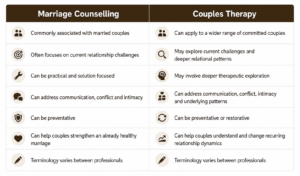
The biggest takeaway is simple:
Do not choose a professional simply because their website says “counselling” or “therapy.” Look at their training, experience, approach and whether they understand the specific challenges you are facing. Because ultimately, the goal is not to win the argument over what your service should be called, The goal is to build a healthier relationship.
Which One Do You Need: Marriage Counselling or Couples Therapy?
By now, you can see why the terms marriage counselling and couples therapy can be confusing. There is considerable overlap between them, and different professionals may use the terms differently.
So if you are sitting with your spouse or partner wondering, “Which one should we actually choose?”, start with the problem rather than the label.
The most helpful question is: What is happening in our relationship, and what kind of support do we need to move forward?
Your answer will give you a much clearer starting point.
Marriage Counselling May Be a Good Starting Point If…
Marriage counselling may be appropriate when you want structured, practical support to improve your relationship and address challenges before they become more deeply rooted.
You may benefit from marriage counselling if:
You Keep Having the Same Arguments
You resolve an issue today, only to have the exact same disagreement next week.
Perhaps the argument is about money, chores, communication, family or intimacy. The topic may change, but the pattern remains.
Professional guidance can help you identify the pattern and develop healthier ways to handle disagreements.
Communication Has Become Difficult
You may feel that your spouse does not listen, understand or take your concerns seriously.
Perhaps conversations quickly become defensive, critical or emotionally overwhelming.
Marriage counselling can help you learn how to express concerns clearly, listen more effectively and create a healthier environment for difficult conversations.
You Feel Emotionally Disconnected
You still love each other, but you no longer feel as close as you once did.
Work, parenting, financial pressure and other responsibilities can gradually push couples into survival mode. Counselling can help you intentionally rebuild friendship, emotional connection and partnership.
You Want to Strengthen an Already Healthy Marriage
You do not have to be in crisis before seeking marriage counselling.
Some couples seek support because they want to communicate better, prepare for a new season or strengthen their marriage before predictable challenges create unnecessary strain.
Prevention is a valid reason to seek relationship support.
Couples Therapy May Be Worth Considering If…
Couples therapy may be particularly useful when the difficulties in your relationship seem deeper or more persistent.
For example:
The Same Relational Cycle Keeps Repeating
You have tried talking about the problem many times, but somehow you always end up in the same place.
One person withdraws. The other pursues. One becomes defensive. The other becomes more critical. Eventually, both feel unheard.
When a pattern has become deeply established, you may need support to understand what is maintaining it and how to change it.
Past Experiences Are Affecting Your Relationship
Sometimes your current conflict is connected to experiences that happened long before you met your partner.
Previous relationships, family experiences, emotional wounds or deeply established beliefs about love and trust can influence how you respond to your spouse.
A therapeutic approach may provide space to explore these patterns and understand how they are affecting the relationship.
Resentment Has Become Deeply Rooted
If hurt has accumulated over months or years without being properly addressed, simply learning a few communication techniques may not be enough.
You may need a structured process that allows both partners to understand the hurt, take responsibility and begin rebuilding the relationship.
Previous Attempts Have Not Worked
Perhaps you have read relationship books, watched videos, had countless conversations or promised each other that things would change.
But nothing seems to stick.
That may be a sign that you need professional guidance rather than another round of trying to solve the problem on your own.
What If You Are Engaged?
You do not have to wait until your wedding day to start preparing for marriage. Premarital counselling can help couples address important issues before they become marital conflicts.
This can include:
- Communication
- Conflict resolution
- Finances
- Family expectations
- Roles and responsibilities
- Emotional and spiritual alignment
- Intimacy
- Core values
- Long term family goals
Dr. Dami’s Future Forward Marriage Preparation Program is designed for dating and engaged couples who want to build a strong foundation for marriage. It incorporates SYMBIS certified premarital coaching alongside practical work around communication, conflict resolution, financial planning, expectations, emotional and spiritual alignment.
What If Your Partner Does Not Want Counselling?
This is more common than you might think, to avoid turning professional help into a threat: “If you loved me, you would go to counseling.” Instead, explain what you hope to achieve.
You could say:
“I don’t want us to wait until things get worse. I would like us to have someone help us understand each other better and strengthen our marriage.”
If your partner remains unwilling, you can still seek individual guidance to understand your own responses, boundaries and contribution to the relationship. The goal is not to force your partner into a process, the goal is to create an opportunity for healthier change.
Ultimately, whether you choose marriage counselling or couples therapy, the right support should help you gain clarity, develop healthier relationship skills and build a stronger foundation for the future.
And sometimes, the most important decision is not choosing between the two. It is deciding to stop waiting for the problem to fix itself.
10 Signs You May Need Marriage Counselling
You do not need to experience every sign on this list before seeking help. Even one persistent issue can be worth addressing if it is affecting your connection or ability to function well as a couple.
1. You Keep Having the Same Argument
If you have discussed the same issue countless times but never seem to reach a lasting resolution, there may be a deeper pattern that needs attention.
The problem is no longer just the argument itself. It is the cycle the two of you have developed around it.
2. Communication Has Become Hostile or Avoidant
Perhaps every serious conversation turns into criticism, shouting or defensiveness, or maybe you have gone in the opposite direction and stopped talking altogether.
Silence may create temporary peace, but unresolved issues rarely disappear simply because you stop discussing them.
3. You Feel Emotionally Disconnected
You may still live together, share responsibilities and function as a family, yet feel increasingly distant from your spouse.
If you cannot remember the last time you had a meaningful conversation, laughed together or felt genuinely understood, it may be time to pay attention to the emotional health of your marriage.
4. Resentment Keeps Growing
Resentment often develops when hurt remains unresolved, you may find yourself keeping score, replaying old arguments or interpreting your partner’s current actions through the lens of past disappointments.
When resentment becomes part of everyday interaction, professional support can help couples address the underlying hurt rather than continually fighting about its symptoms.
5. Trust Has Been Damaged
Trust can be affected by dishonesty, secrecy, broken promises or betrayal. Rebuilding it usually requires more than an apology.
Both partners may need a structured process for understanding what happened, taking responsibility, creating transparency and demonstrating consistent change.
6. You Avoid Difficult Conversations
If you regularly think, “It is not worth bringing this up,” take that seriously. Healthy marriages do not require couples to agree on everything. They do require enough emotional safety to discuss important things honestly.
Avoiding every difficult conversation can allow small problems to quietly become larger ones.
7. Intimacy Has Changed Significantly
Changes in emotional or physical intimacy can sometimes signal deeper relational difficulties.
If affection, closeness or sexual intimacy has declined and neither of you understands why, professional guidance can create a safer environment for addressing what may be difficult to discuss alone.
8. External Pressures Are Overwhelming Your Relationship
Marriage does not exist in a vacuum. Career demands, financial stress, parenting, extended family responsibilities, health challenges and major life transitions can place significant pressure on a couple.
The problem is not always that the marriage is unhealthy. Sometimes the couple simply needs better tools for navigating a demanding season together.
This is particularly relevant for young African professionals who may be balancing demanding careers with family expectations, cultural responsibilities and the realities of building a future together.
9. You Are Seriously Considering Separation or Divorce
If conversations about separation or divorce have become frequent, do not assume you have to wait until one person has completely checked out.
Professional support may help you understand what has happened, what can realistically be repaired and what decisions need to be made.
The earlier you seek appropriate help, the more opportunity there may be to address unresolved issues before they become even more entrenched.
10. You Simply Want a Stronger Marriage
This one is important, you do not need a crisis to justify counselling. Perhaps your marriage is good, but you want it to become better.
You may want to improve communication, deepen emotional intimacy, clarify your shared vision or prepare for a new stage of family life, that is not overreacting, that is intentional marriage building.
Ask Questions Before You Commit
Before booking a longer programme, consider asking the professional:
“What happens during the first session?”
“What kind of couples do you typically work with?”
“What training do you have in couples work?”
“How do you approach conflict between partners?”
“Do you work with Christian couples?”
“How do you determine what kind of support a couple needs?”
“What happens if one partner is reluctant to participate?”
The answers can tell you a lot about whether the professional is likely to be a good fit.
The Right Professional Should Help You Move Forward
Ultimately, choosing between marriage counseling and couples therapy is only part of the decision.
Choosing the right person is just as important.
Look beyond the title, look at their training, experience, approach, values, cultural understanding and ability to work with the specific challenges affecting your relationship.
And perhaps most importantly, look for someone who can help you move beyond simply surviving your current conflict toward building a healthier and more intentional marriage.
Because the goal of professional relationship support should not simply be to help you get through today’s argument.
It should help you develop the understanding and skills to build a marriage that can thrive in the seasons ahead.
Frequently Asked Questions, and How Dr. Dami Can Help
By now, you should have a clearer understanding of the difference between marriage counselling and couples therapy.
The important thing to remember is that the terms can overlap. Different professionals may use them differently, so choosing the right support should be based on your relationship needs, the professional’s training, their approach and the outcomes you want to achieve.
Here are some of the most common questions couples ask.
Frequently Asked Questions About Marriage Counselling and Couples Therapy
-
Is marriage counselling the same as couples therapy?
Not exactly, but there is significant overlap.
Marriage counselling is commonly associated with helping married couples address relationship challenges, improve communication and strengthen their marriage. Couples therapy is a broader term that can apply to committed couples and may also involve deeper exploration of emotional and relational patterns.
However, professionals do not all use these terms in exactly the same way.
-
Is couples therapy better than marriage counselling?
No. One is not automatically better than the other.
The more important question is whether the professional you choose has the right training, experience and approach for your particular relationship.
A couple struggling with communication may benefit from structured counselling, while another couple dealing with longstanding emotional wounds may need a deeper therapeutic approach.
What matters is getting the right kind of support for the problem you are actually facing.
-
Does marriage counselling work?
Marriage counselling can help couples develop healthier communication, understand recurring relationship patterns and work through challenges.
However, counselling cannot guarantee a particular outcome. Progress depends on several factors, including the nature of the problem, the professional’s approach, the willingness of both partners to participate and the couple’s commitment to applying what they learn outside the sessions.
Counselling is not a magic fix, it is a structured opportunity to understand what is happening and make meaningful changes.
-
When should couples seek marriage counselling?
You do not need to wait until your marriage is in crisis. Consider seeking professional support when you notice persistent communication problems, repeated conflict, emotional disconnection, damaged trust, growing resentment or significant changes in intimacy.
You can also seek counseling when your marriage is healthy but you want to strengthen it and prepare for future seasons.
Early support is often better than waiting until years of unresolved problems have accumulated.
-
Can marriage counseling help after infidelity?
It can. However, rebuilding after infidelity requires more than simply deciding to forgive and move forward.
Couples may need to work through the hurt, establish accountability, rebuild trust, improve communication and gradually restore emotional and physical intimacy.
Dr. Dami’s Affair Recovery Program is designed around these areas, providing a structured approach to healing, accountability, communication repair, trust restoration and reconciliation. >>Click Here to Get Started with Affairs Recovery<<
-
Can marriage counseling prevent divorce?
Marriage counselling cannot promise that a couple will never divorce. However, professional support can help couples address problems earlier, develop healthier relationship patterns and make more informed decisions about their marriage.
The goal should not be to make unrealistic promises about outcomes.
The goal is to help couples understand their relationship, take responsibility for what they can change and intentionally work toward a healthier future.
How Dr. Dami Can Help
At The Family Life Doctor, Dr. Dami helps individuals and couples build strong, resilient and purpose driven families by combining Christian values, research based strategies and practical relationship guidance.
His approach is designed around the belief that healthy families do not happen by accident. They are built through intentionality, knowledge, emotional maturity, healthy communication and a clear vision for the future.
This approach is particularly relevant for young African professionals who are navigating marriage alongside demanding careers, faith, finances, family responsibilities and changing cultural expectations.
Whether you are preparing for marriage, strengthening a new marriage, rebuilding connection or working through serious marital challenges, the first step is gaining clarity about what your relationship actually needs.
Not Sure Where to Start?
You do not have to decide between marriage counselling, couples therapy or another form of relationship support on your own.
Start with a Clarity Session with Dr. Dami.
The 45 minute Clarity Session is designed to help you understand your current situation, identify the key areas that need attention and determine the most appropriate next step before committing to a more comprehensive programme.