
Imagine this scenario, your spouse mentions that they’ve been working closely with a colleague and have exchanged a few messages after office hours to finish an important project. Something inside you shifts, your heart beats a little faster, questions begin to flood your mind. Why are they texting so late? Why didn’t they mention this before? Should I be worried?
Now imagine two very different responses.
One person says, “I’ve been feeling a little uneasy lately. Can we talk about what’s been going on? I want to understand because our relationship matters to me.”
Another says, “You’re obviously hiding something, delete their number right now, or this relationship is over.”
Both responses are triggered by discomfort and both arise from the possibility of losing someone important. Yet they come from two completely different emotional places. One is motivated by love seeking understanding while the other is driven by fear demanding control. This is where many people get confused.
We often assume that jealousy is simply proof that someone cares deeply. After all, popular culture romanticizes it, movies portray jealous partners as passionate lovers, friends sometimes joke that “if they’re not jealous, they don’t really love you.” Even social media has normalized controlling behaviors as signs of commitment, but real life tells a different story.
Healthy relationships are not built on suspicion, surveillance, or emotional manipulation. They are built on trust, honest communication, emotional safety, and mutual respect. While genuine concern can protect a relationship from real threats, unchecked jealousy slowly erodes the very connection it is trying to preserve.
The truth is, not every uncomfortable feeling is unhealthy, there are moments when concern is appropriated. If your partner suddenly becomes secretive, consistently breaks agreed-upon boundaries, or behaves in ways that undermine trust, paying attention is not insecurity, it is wisdom. The challenge lies in knowing when your emotions are alerting you to a genuine issue and when they are amplifying fears that exist within you rather than problems that exist between you.
As a family life practitioner, I have seen countless individuals and couples struggle with this distinction. Some dismiss legitimate concerns because they don’t want to appear “jealous,” others justify controlling behaviors by calling them “care.” Unfortunately, both extremes damage intimacy. One ignores problems that need to be addressed, while the other creates problems that never existed in the first place.
Understanding the difference between jealousy and healthy concern is one of the most important skills you can develop if you want a thriving relationship or marriage. It doesn’t just improve communication, it strengthens trust, deepens emotional intimacy, and creates the kind of emotional safety where love can flourish.
What Is Jealousy? Understanding the Emotion Behind the Fear
Jealousy is one of the most misunderstood emotions in relationships. It is often portrayed as proof of deep love or intense passion, you may have heard people say, “If they’re not jealous, they don’t really care.” Movies, music, and social media have reinforced this idea for years, making possessiveness appear romantic and emotional control seem like a sign of commitment.
In reality, jealousy is neither a measure of love nor an indicator of a healthy relationship. It is an emotional response to a perceived threat, whether that threat is real or imagined. At its core, jealousy is the fear of losing someone or something you deeply value.
Understanding this distinction is the first step toward building healthier relationships. Jealousy itself is not the enemy, the real issue lies in how we interpret our feelings and the actions we take because of them.
Jealousy Is Different from Envy
Envy is wanting something someone else has. You envy another person’s success, wealth, career, or relationship.
Jealousy, however, involves the fear of losing something you already have. It usually emerges when a third person, or even the possibility of one, is perceived as threatening an important relationship.
For example:
- Envy says, “I wish I had a marriage like theirs.”
- Jealousy says, “I’m afraid someone else will take my spouse away from me.”
This distinction matters because the solutions are different. Envy often calls for gratitude and contentment, while jealousy requires self-awareness, trust, and emotional security.
What Is Jealousy Really Trying to Protect?
Although jealousy often appears as anger, suspicion, or possessiveness, those outward reactions usually conceal much deeper emotions.
Beneath jealousy, there is often a fear that sounds like this:
- I’m afraid I’m not enough.
- I’m afraid I’ll be abandoned.
- I’m afraid someone better will replace me.
- I’m afraid I’ll be betrayed.
- I’m afraid I’ll be hurt again.
In other words, jealousy is rarely about another person alone. It is frequently about our own sense of safety, worth, and security.
This is why two people can experience the exact same situation and respond completely differently. One partner may notice their spouse chatting with an old friend and think nothing of it because trust has been established. Another may immediately assume emotional infidelity, not because the evidence supports it, but because past experiences have conditioned them to expect betrayal. The external event may be identical, but the internal story is completely different.
The Psychology Behind Jealousy
Relationship researchers have found that jealousy is often connected to our attachment style, emotional history, and personal beliefs about ourselves.
Individuals who grew up in emotionally inconsistent or unpredictable environments may develop an anxious attachment style. As adults, they may become hypervigilant to signs of rejection or abandonment, even when no genuine threat exists. Small changes in communication, delayed responses to messages, or innocent interactions with others can trigger intense emotional reactions.
Past experiences also play a significant role. Someone who has experienced infidelity, emotional neglect, broken trust, or repeated rejection may carry those wounds into future relationships. Their mind becomes conditioned to anticipate disappointment, making it difficult to distinguish between present reality and past pain.
Low self-esteem can have a similar effect. When a person’s confidence depends heavily on being accepted or affirmed by their partner, every perceived threat feels catastrophic. Instead of believing, “My partner loves me,” they quietly wonder, “What if someone else is better than me?”
This is why jealousy often tells us more about our internal emotional landscape than it does about our partner’s behaviour.
Jealousy Is a Signal, Not a Verdict
One of the biggest mistakes people make is believing that feeling jealous automatically means something is wrong in the relationship. Well, not necessarily because emotions are signals, not verdicts.
Feeling jealous does not automatically prove that your partner is being unfaithful. Likewise, it does not automatically mean you are emotionally unhealthy. It simply tells you that something inside you requires attention.
The important question is not, “Am I jealous?”
The more important question is, “Why am I jealous?”
Is your concern based on clear evidence, or is it rooted in assumptions? Is your reaction responding to your partner’s behaviour, or is it being shaped by unresolved fears from your past? The answers to those questions make all the difference.
A Biblical Perspective on Jealousy
The Bible presents jealousy as a powerful emotion that can either destroy relationships or reveal the condition of the human heart.
King Saul’s jealousy toward David is one of Scripture’s clearest examples. David had faithfully served Saul and achieved great victories for Israel, yet when the people celebrated David’s success, Saul’s insecurity grew into obsessive jealousy. What began as comparison eventually became suspicion, hatred, and repeated attempts to take David’s life. David had not become Saul’s enemy, Saul’s unchecked jealousy made him see an enemy where there wasn’t one.
We also see jealousy in the story of Joseph and his brothers. Their father’s favouritism stirred resentment that eventually led them to sell Joseph into slavery. Their jealousy distorted their judgment and fractured their family for years.
These accounts remind us that jealousy, when left unaddressed, has the power to damage relationships, cloud discernment, and lead people to act against their own values.
The Key Takeaway
Jealousy is a normal human emotion, but it is not a reliable guide for making relationship decisions.
Feeling jealous does not make you toxic, controlling, or incapable of having a healthy relationship. It simply invites you to pause and examine what is happening beneath the surface. The goal is not to suppress jealousy or pretend it does not exist. The goal is to understand it well enough that it no longer controls your words, your actions, or your relationship.
As we’ll discover next, there is another emotion that can look remarkably similar on the surface but produces completely different outcomes. It is called healthy concern, and knowing the difference could transform the way you love, communicate, and protect your relationship.
What Is Healthy Concern? The Kind of Care That Strengthens Relationships
If jealousy is driven by the fear of losing someone, healthy concern is driven by the desire to protect the relationship. Although both emotions can begin with the same feeling of discomfort, they lead to completely different behaviours and outcomes.
This distinction is crucial because many people mistake controlling behaviour for care. They believe that constant monitoring, endless questioning, or demanding access to every aspect of their partner’s life is simply evidence of love. In reality, these behaviours often reveal insecurity rather than genuine concern.
Healthy concern doesn’t seek to control the person you love, it seeks to understand what is happening and preserve the trust between you.
Healthy Concern Is Rooted in Love, Not Fear
Every thriving relationship has moments that require concern. If your spouse suddenly becomes emotionally distant, begins hiding important information, or repeatedly violates agreed-upon boundaries, it would be unwise to ignore those changes. Love is not blind; it pays attention.
However, healthy concern responds differently from jealousy, instead of assuming the worst, it creates space for honest conversations. Instead of making accusations, it seeks clarity. Instead of reacting impulsively, it responds thoughtfully.
Healthy concern says,
“Something feels different between us, and I’d like us to talk about it.”
Jealousy says,
“I already know you’re hiding something.”
One response invites connection, while the other creates defensiveness. Healthy concern understands that trust is too valuable to be sacrificed on the altar of assumptions.
Healthy Concern Protects the Relationship, Not the Ego
One of the simplest ways to distinguish healthy concern from jealousy is to ask yourself this question:
“What am I trying to protect?”
If your goal is to protect your partner, your relationship, and the trust you’ve built together, your concern is likely moving in a healthy direction.
If your primary goal is to protect your pride, control your partner’s choices, or eliminate every possibility of discomfort, jealousy has probably taken over. This difference may seem subtle, but it changes everything.
Healthy concern recognizes that relationships require honesty, accountability, and appropriate boundaries. It acknowledges that trust should not be naïve, instead, trust grows when two people consistently demonstrate integrity, transparency, and respect for one another.
Jealousy, however, often demands certainty that no relationship can realistically provide. It wants guarantees instead of trust, it seeks complete control over situations that ultimately cannot be controlled. Ironically, the harder jealousy tries to prevent abandonment, the more likely it is to create emotional distance.
Healthy Concern Makes Room for Conversation
Communication is one of the clearest indicators of whether your emotions are rooted in healthy concern or jealousy. When concern is healthy, difficult conversations become invitations rather than interrogations, instead of beginning with accusations, healthy concern begins with curiosity.
It asks questions like:
- “Can you help me understand what happened?”
- “I’ve noticed we’ve seemed disconnected lately, have you felt that too?”
- “I’m feeling a little unsettled, and I’d like to hear your perspective.”
- “Can we talk about something that’s been on my mind?”
These questions communicate vulnerability rather than hostility. They allow both partners to explore the issue together instead of forcing one person into a defensive position.
Jealousy, on the other hand, often skips conversation altogether. It assumes motives, reaches conclusions before gathering facts, and turns uncertainty into certainty without evidence.
Statements such as, “I know exactly what you’re doing,” or, “Don’t lie to me,” leaves little room for understanding because the verdict has already been delivered.
Healthy Concern Respects Boundaries While Seeking Transparency
Every healthy relationship requires both trust and appropriate boundaries. These two qualities are not opposites, they complement each other.
Healthy concern understands that transparency is something partners willingly offer because they value the relationship, not something that is extracted through pressure or surveillance. For example, a husband may choose to tell his wife about a new friendship at work because openness strengthens trust. Likewise, a wife may voluntarily share her concerns about an interaction that made her uncomfortable because honesty builds intimacy.
Neither partner is acting out of fear, they are choosing transparency because they understand that healthy marriages thrive in environments where nothing important is hidden.
Jealousy, however, confuses transparency with constant monitoring, it insists on knowing every password, it demands explanations for every delayed response, it treats privacy as evidence of guilt, it assumes that unrestricted access is the same thing as trust. But true trust is never built through surveillance. It is built through consistent character, honest communication, and mutual respect.
Healthy Concern Is Willing to Be Wrong
Perhaps one of the strongest signs that your concern is healthy is your willingness to accept that your assumptions might be incorrect.
Healthy concern approaches conversations with humility. It says, “Based on what I’ve observed, this is how I’m feeling. but I’m open to hearing your side.” While jealousy rarely allows for that possibility, it often treats feelings as facts; if I feel threatened, then there must be a threat, if I feel suspicious, then my partner must be guilty.
This emotional reasoning creates unnecessary conflict because feelings, while important, are not always accurate reflections of reality. Emotional maturity requires us to honour our feelings without allowing them to become our only source of truth.
Healthy Concern Builds Emotional Safety
One of the greatest gifts you can offer your partner is emotional safety, the confidence that they can be honest without immediately being judged, attacked, or condemned.
When healthy concern guides your actions, your partner feels safe enough to share difficult truths, admit mistakes, and have vulnerable conversations. This openness strengthens intimacy because both people know they can approach sensitive topics without fear of emotional retaliation.
Jealousy has the opposite effect. When every conversation becomes an interrogation, people naturally become more guarded. They begin withholding information, not necessarily because they are being dishonest, but because they are trying to avoid unnecessary conflict.
Over time, this creates the very distance that jealousy fears most.
Healthy concern invites honesty while jealousy often discourages it.
Healthy Concern vs. Jealousy: Spotting the Difference
Although they can feel similar at the moment, their patterns are remarkably different.
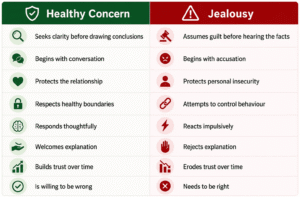
When you look closely, the difference isn’t simply in what each emotion feels like, it’s in what each emotion produces. Healthy concern nurtures intimacy because it is grounded in love, humility, and trust, while jealousy weakens intimacy because it is driven by fear, insecurity, and the need for control.
10 Signs You’re Experiencing Jealousy Instead of Healthy Concern
Not every uncomfortable feeling in a relationship is unhealthy, sometimes your intuition alerts you to a genuine issue that deserves attention. But there are also times when what feels like “concern” is actually jealousy wearing a more acceptable disguise.
The challenge is that jealousy rarely announces itself, it often presents as love, protection, or even wisdom. It convinces you that you’re simply being careful, when in reality you’re being controlled by fear.
So how can you tell the difference? Here are ten signs that your emotions may be rooted more in jealousy than in healthy concern.
1. You Constantly Need Reassurance
Everyone appreciates hearing “I love you” or being reminded that they matter. But when reassurance becomes a daily requirement instead of an occasional comfort, it may signal a deeper issue.
You repeatedly ask questions like:
- “Do you still love me?”
- “Are you sure you’re happy with me?”
- “You’re not going to leave me, are you?”
Even after your partner reassures you, the peace doesn’t last. Within hours or days, you find yourself needing the same confirmation again. The problem isn’t that your partner isn’t reassuring enough, It’s that reassurance can never permanently silence an insecurity that hasn’t been healed.
2. You Imagine the Worst Before You Know the Facts
Your partner doesn’t answer their phone for two hours, instead of considering several possible explanations, your mind immediately jumps to the darkest conclusion.
“They’re ignoring me.”
“They’re with someone else.”
“They’re hiding something.”
This is called catastrophic thinking, assuming the worst possible explanation without sufficient evidence.
3. You Feel Compelled to Check Their Phone or Social Media
You tell yourself you’re “just making sure.” You scroll through messages, check who liked their photos, examine their followers, monitor when they were last online.
Perhaps you’ve even memorized passwords, not because your partner willingly shared them as part of mutual transparency, but because you feel you need access to feel secure, while transparency can strengthen a relationship, surveillance weakens it. Trust cannot flourish where investigation becomes a lifestyle.
If you constantly feel the need to search for evidence, ask yourself an important question: Am I looking for truth, or am I looking for confirmation of my fears?
4. Every Friendship Feels Like Competition
Healthy people understand that committed relationships can coexist with healthy friendships. Jealousy, however, struggles with this idea. Every colleague becomes a threat, every old friend becomes suspicious, every interaction with someone of the opposite sex feels dangerous.
Instead of evaluating individual situations wisely, jealousy paints every relationship with the same brush. This often places impossible expectations on your partner, leaving them feeling isolated and distrusted.
A healthy relationship should expand your world, not shrink it through fear.
5. You Interpret Innocent Behaviour as Evidence of Betrayal
Jealousy has a remarkable ability to assign negative motives to ordinary actions. Your partner smiles while texting and you assume they’re flirting, they mention a colleague’s name and you assume there’s emotional intimacy, they arrive home later than expected because of traffic and you assume they’re lying. Notice the pattern, the behaviour itself isn’t the problem, the problem is the interpretation.
Jealousy filters neutral events through suspicion, causing ordinary moments to become imagined threats. Over time, this creates unnecessary conflict because your partner feels judged for actions that were never intended to cause harm.
6. You Become Angry Before Asking Questions
Healthy concern is curious, jealousy is reactive. Instead of asking, “Can you help me understand what happened?” you begin with accusations. “You’re lying.” “I know exactly what you’re doing.” “Don’t make excuses.”
When emotions are driving the conversation before facts have been established, jealousy has likely taken the driver’s seat.
Strong relationships aren’t built on assumptions, they are built on conversations. Choosing curiosity over accusation creates room for truth to emerge.
7. You Try to Control Rather Than Connect
One of the clearest signs of unhealthy jealousy is the desire to control your partner’s behaviour.
You may insist they:
- stop talking to certain friends
- avoid specific colleagues
- share their live location at all times
- ask permission before making ordinary decisions
- account for every minute of their day
While some boundaries are healthy and mutually agreed upon, control is different. Boundaries protect both people, while control protects one person’s anxiety.
The more jealousy grows, the more it mistakes obedience for security, but genuine love cannot thrive where freedom is replaced by fear.
8. Your Mood Depends on Your Partner’s Every Move
Your emotional stability rises and falls based entirely on your partner’s behaviour. If they reply quickly, you feel secure and if they don’t, your day is ruined. If they compliment you, you’re confident and if they’re distracted because of work, you assume something is wrong.
This emotional rollercoaster places enormous pressure on the relationship because your partner becomes responsible for regulating emotions that only you can ultimately manage. Healthy love creates emotional connection, It does not create emotional dependence.
Learning to regulate your own emotions is one of the greatest gifts you can give your relationship.
9. You Struggle to Celebrate Your Partner’s Independence
Healthy relationships consist of two whole people choosing to build a shared life together. Jealousy often sees independence as rejection. If your partner enjoys time with friends, pursues personal interests, or succeeds professionally, you may secretly feel threatened instead of supportive.
You begin to wonder: “Why don’t they need me more?” “Why do they enjoy spending time with other people?” In reality, healthy marriages make room for individuality. Partners don’t lose themselves when they commit to each other, they grow together while still remaining distinct individuals. Love celebrates healthy independence while jealousy fears it.
10. No Amount of Reassurance Ever Feels Like Enough
This is perhaps the strongest indicator that jealousy, not healthy concern, is driving your emotions. Your partner has answered your questions, they’ve been transparent, they’ve apologised where necessary, they’ve consistently demonstrated trustworthy behaviour, yet the suspicion remains.
You continue searching for hidden evidence because you believe the real truth simply hasn’t been discovered yet. At this point, the issue is no longer your partner’s behaviour, the issue is the unresolved fear within you.
No amount of reassurance can permanently heal an insecurity that requires personal growth, emotional healing, or professional support, until the root is addressed, the cycle simply repeats itself.
Where Does Jealousy Really Come From?
If you’ve ever struggled with jealousy, it’s tempting to believe the problem is simply your partner’s behaviour.
“If they would stop talking to that person, I wouldn’t feel this way.”
“If they were more reassuring, I wouldn’t be so anxious.”
“If they loved me better, I’d stop worrying.”
Sometimes, there may be genuine relationship issues that need to be addressed, but more often than we realize, jealousy has roots that extend far beyond the current relationship.
Think of jealousy like the warning light on a car’s dashboard, the light isn’t the problem, it’s a signal that something underneath the surface needs attention. If you only cover the warning light without fixing the engine, the problem doesn’t disappear; it simply becomes more dangerous.
In the same way, jealousy is often a symptom of deeper emotional wounds, unresolved experiences, and unhealthy beliefs about ourselves and relationships.
Understanding where jealousy comes from is essential because you can’t heal what you don’t understand.
1. Childhood Attachment Shapes Adult Relationships
Long before we entered romantic relationships, we were learning what love, safety, and connection looked like.
Our earliest relationships, usually with parents or caregivers, form what psychologists call our attachment style. These early experiences influence how we relate to others throughout adulthood.
If your caregivers were emotionally available, consistent, and responsive, you were more likely to develop a secure attachment. As an adult, you can generally trust others while maintaining your own emotional stability.
But if love was unpredictable, inconsistent, or emotionally unavailable, your nervous system may have learned a different lesson:
“People leave.”
“Love isn’t reliable.”
“I have to fight to keep people close.”
As adults, these beliefs often surface as jealousy. A delayed text message doesn’t simply feel like delayed communication, it feels like rejection. A cancelled date doesn’t feel like an inconvenience, it feels like abandonment.
The current situation awakens fears that were planted years earlier, this doesn’t mean your childhood determines your future, but it does explain why two people can experience the same relationship situation and interpret it in completely different ways.
2. Past Betrayal Can Make Trust Feel Dangerous
Few experiences leave emotional scars like betrayal. Perhaps you’ve been cheated on before, maybe someone lied to you repeatedly, perhaps someone you trusted walked away unexpectedly.
These experiences teach painful lessons, and unless they’re processed, they often become the lens through which every future relationship is viewed.
Your mind begins trying to protect you from ever being hurt again, it becomes hypervigilant, you notice every small inconsistency, you overanalyse conversations, you search for hidden meanings, you prepare for heartbreak before it happens.
While this may feel like wisdom, it’s actually self-protection driven by fear. The tragedy is that an innocent partner can end up paying the emotional price for wounds they never caused.
Healing doesn’t mean pretending betrayal never happened, it means refusing to let yesterday’s pain dictate today’s relationships.
3. Low Self-Esteem Makes Everyone Feel Like Competition
At the heart of many jealous reactions lies a quiet question: “Am I enough?”
When your sense of worth is fragile, every attractive colleague, successful friend, or confident stranger begins to feel like a threat. You assume your partner will eventually discover someone better, someone more attractive, more successful, more interesting, more accomplished.
This comparison mindset feeds jealousy because it convinces you that love is a competition rather than a commitment. The healthier your self-worth becomes, the less threatened you feel by the strengths of others.
Confident people don’t believe they’re the best at everything, they simply believe they are enough. That quiet confidence creates emotional security that no amount of external reassurance can replace.
4. Emotional Insecurity Creates False Alarms
Emotionally insecure people often depend heavily on external validation to feel safe, their mood rises and falls based on their partner’s attention, affection, or availability. Instead of finding security within themselves, they constantly seek it from someone else.
This creates enormous pressure on the relationship because no partner can permanently provide the internal security another person lacks. True emotional security is built from within.
Healthy relationships strengthen that security, they cannot create it.
5. Unresolved Trauma Changes the Way You Interpret Reality
Trauma doesn’t simply affect your memories, it changes how your brain interprets present experiences.
If you’ve experienced abandonment, abuse, neglect, or repeated emotional pain, your nervous system becomes highly sensitive to anything that resembles those earlier experiences. Psychologists sometimes describe this as living in a constant state of emotional alertness. You’re not necessarily reacting to what’s happening now, You’re reacting to what your brain believes might happen based on what happened before.
This explains why relatively small events can trigger disproportionately intense emotional reactions. Your partner arriving home thirty minutes late isn’t just about traffic, your nervous system remembers every previous disappointment and sounds the alarm.
Recognizing this pattern isn’t about blaming your past, it’s about understanding why your present sometimes feels more threatening than it actually is.
6. Fear of Abandonment Fuels Controlling Behaviour
At its deepest level, jealousy is often driven by one overwhelming fear: “The person I love will leave me.” Ironically, this fear often creates the very outcome it desperately wants to avoid.
People who fear abandonment may:
- become excessively possessive
- demand constant reassurance
- avoid giving their partner personal space
- overreact to minor disagreements
- try to control every aspect of the relationship
Initially, these behaviours may appear to create closeness, but over time, they create emotional exhaustion. No one enjoys feeling constantly monitored, love thrives in an atmosphere of trust while fear suffocates it.
7. Social Media Has Intensified Comparison and Suspicion
Never before have people had such unprecedented access to each other’s lives. With a few taps, you can see who liked your partner’s photo, who commented, who followed them, who viewed their story. While technology has made communication easier, it has also made comparison and suspicion easier.
A harmless interaction can quickly become the subject of hours of overthinking. Algorithms constantly expose us to carefully curated images of seemingly perfect relationships, creating unrealistic expectations and unnecessary insecurity.
The problem isn’t social media itself, the problem is allowing digital information to become the primary source of emotional interpretation.
Healthy relationships are built through real conversations, not endless online investigations.
8. Unrealistic Expectations Set Relationships Up to Fail
Some people unconsciously expect their partner to meet every emotional need they have; to always understand, always reassure, always prioritise them, always respond immediately, always make them feel secure. No human being can sustain those expectations.
Healthy marriages are built by two imperfect people choosing each other consistently, not by two perfect people never disappointing each other. When expectations become unrealistic, ordinary human imperfections begin to feel like evidence of rejection.
Managing expectations is one of the most overlooked ways to reduce unnecessary jealousy.
How to Respond When You Feel Jealous
Feeling jealous does not make you a bad partner, it makes you human.
Every committed relationship will eventually present moments that trigger insecurity. Your spouse may develop a close friendship at work, become busier than usual, or behave in ways you don’t immediately understand. In those moments, the goal isn’t to pretend you don’t feel anything. Emotional maturity isn’t the absence of difficult emotions, it is the ability to respond to those emotions wisely.
The difference between healthy couples and struggling couples is not that one group never experiences jealousy. The difference is that healthy couples know how to process those feelings without allowing them to control their behaviour.
The good news is that jealousy doesn’t have to dictate your decisions. Like every emotion, it can become an invitation for growth rather than a trigger for conflict.
Here are seven practical steps to help you respond wisely when jealousy arises.
Step 1: Pause Before You React
When jealousy strikes, your body often responds before your mind has had a chance to evaluate the situation, your heart races, your thoughts accelerate and your emotions intensify.
In those moments, your instinct may be to send an angry message, demand explanations, or accuse your partner before you’ve gathered the facts.
Resist that urge, one of the greatest relationship skills you can develop is the ability to pause.
A brief pause allows your emotional brain to settle so your rational mind can engage.
Instead of reacting immediately, ask yourself:
- What actually happened?
- What evidence do I have?
- What assumptions am I making?
Sometimes the greatest act of love is choosing not to react until you’ve had time to think clearly. Remember: A delayed response is often wiser than an immediate reaction.
Step 2: Identify the Real Emotion Beneath the Jealousy
Jealousy is rarely the primary emotion, it is usually a secondary emotion that covers something deeper. Instead of simply saying, “I’m jealous,” dig beneath the surface.
Ask yourself:
- Am I afraid of being replaced?
- Am I feeling unimportant?
- Do I fear abandonment?
- Am I carrying wounds from a previous relationship?
- Do I feel insecure about myself?
- Am I worried because trust has genuinely been broken before?
Naming the deeper emotion changes the conversation, instead of attacking your partner, you begin understanding yourself. self-awareness transforms emotional reactions into opportunities for healing.
As Proverbs 4:23 reminds us:
“Above all else, guard your heart, for everything you do flows from it.”
Guarding your heart doesn’t mean ignoring your emotions, it means understanding them before acting on them.
Step 3: Separate Facts from Assumptions
One of jealousy’s greatest strengths is making assumptions feel like facts. Before responding, create two mental lists.
The Facts
These are things you know to be objectively true.
For example:
- My partner arrived home later than expected.
- They mentioned having lunch with a colleague.
- They forgot to call me yesterday.
The Assumptions
These are the stories your mind has created.
For example:
- They must be cheating.
- They’re losing interest in me.
- They’re hiding something.
- They don’t love me anymore.
Notice the difference? Facts describe events while assumptions interpret them. Healthy relationships are built on facts discussed through honest communication, not assumptions fueled by fear.
Whenever possible, let evidence guide your conclusions instead of allowing anxiety to write the story.
Step 4: Communicate with Vulnerability Instead of Accusation
Once you’ve processed your emotions, the next step is to have an honest conversation. The way you begin that conversation often determines how it will end.
Compare these two approaches.
Accusation
“You’re always hiding things from me.”
“I know you’re lying.”
“Who exactly were you with?”
These statements immediately trigger defensiveness.
Now compare them with;
Vulnerability.
“I’ve been feeling a little unsettled lately, and I’d like to talk about it.”
“Can you help me understand something that’s been on my mind?”
“I know this may be my insecurity speaking, but I’d rather talk about it than make assumptions.”
Notice the difference? One attacks, while the other invites connection. Vulnerability isn’t weakness, it is one of the strongest foundations of emotional intimacy.
Step 5: Invite Collaboration, Not Conflict
Healthy relationships are built by two people solving problems together, not by two opponents trying to defeat each other. When jealousy arises, shift your mindset from:
Me versus You
to
Us versus the Problem.
Instead of asking,
“How do I prove I’m right?”
ask,
“How do we strengthen trust together?”
This simple shift changes the tone of the entire conversation, you move from interrogation to partnership, you begin looking for solutions instead of evidence.
Remember, your partner should never feel like your enemy, the problem is the enemy, not each other.
Step 6: Strengthen Trust Through Daily Habits
Trust isn’t built in one dramatic conversation, it’s built through hundreds of small, consistent moments. Every healthy relationship develops rhythms that make trust easier.
These may include:
- Keeping promises, even the small ones.
- Being transparent about important relationships.
- Communicating when plans change.
- Being emotionally available.
- Following through on commitments.
- Respecting agreed-upon boundaries.
- Speaking truthfully, even when it’s uncomfortable.
Likewise, if you’ve contributed to mistrust in the past, rebuilding confidence requires patience.
Trust grows slowly but can be destroyed quickly. Think of trust as a savings account, every honest conversation is a deposit and every broken promise is a withdrawal. Strong marriages intentionally make more deposits than withdrawals.
Step 7: Heal the Root, Not Just the Symptoms
Many people spend years trying to eliminate jealous thoughts without addressing the deeper wounds that produce them, but lasting freedom comes from healing the source.
Ask yourself honestly:
- Are there childhood experiences I still need to process?
- Have I fully healed from previous betrayal?
- Do I struggle with my own sense of worth?
- Is anxiety affecting the way I interpret my relationship?
Healing may involve:
- Personal reflection and journaling.
- Prayer and Scripture meditation.
- Reading healthy relationship resources.
- Working with a trusted mentor or pastor.
- Professional counselling or relationship coaching.
Healing is not admitting defeat, it is choosing growth over repeated cycles of fear. God never calls us to live imprisoned by insecurity, He calls us into freedom. As 2 Timothy 1:7 reminds us: “For God has not given us a spirit of fear, but of power and of love and of a sound mind.” A sound mind doesn’t deny emotions, it refuses to let fear become their master.
When Your Partner Is the Jealous One
Recognizing jealousy in yourself is challenging enough, but what happens when your partner is the jealous one? Perhaps they question your friendships, ask to see your phone, or repeatedly accuse you of being unfaithful despite having no evidence. Over time, this can become emotionally exhausting.
The solution isn’t to become defensive, or to surrender to unhealthy control, instead, respond with compassion while maintaining healthy boundaries.
1. Listen Beyond the Behaviour
Jealous behaviour is often driven by fear rather than facts. Behind the accusations may be fears of abandonment, betrayal, or not being enough. Instead of arguing, try asking: “Help me understand what’s making you feel this way.” When people feel heard, they’re often more willing to listen.
2. Validate Feelings, Not False Conclusions
You can acknowledge your partner’s emotions without agreeing with their assumptions, instead of saying, “You’re overreacting,” try, “I can see this situation has made you anxious, and I want us to talk about it.”
Validation communicates empathy without confirming accusations.
3. Practice Transparency Without Accepting Control
Healthy relationships value openness, sharing your plans or communicating clearly can strengthen trust. However, transparency should be voluntary, not forced through constant questioning, phone checks, or surveillance.
Trust grows through honesty, not investigation.
4. Set Healthy Boundaries
Boundaries protect both people in the relationship. You might say, “I’m happy to be open because I value our relationship, but I don’t think constantly checking my phone is helping us build trust.”
Supporting your partner doesn’t mean enabling unhealthy behaviour.
5. Encourage Healing
If jealousy persists despite reassurance, the issue is likely deeper than the current relationship; past betrayal, childhood experiences, low self-esteem, or unresolved trauma may be influencing your partner’s reactions.
Encourage honest conversations, counselling, or relationship coaching to address the root cause rather than repeatedly managing the symptoms.
6. Know When Jealousy Becomes Abuse
Jealousy becomes unhealthy when it turns into control.
Warning signs include:
- Constant accusations without evidence
- Monitoring your phone or social media
- Isolating you from family and friends
- Controlling where you go or who you see
- Using guilt, threats, or intimidation to control your behaviour
These are not signs of love, they are signs that fear has become controlling. If your emotional or physical safety is at risk, seek professional support immediately.
If your partner struggles with jealousy, respond with empathy, honesty, and healthy boundaries. Encourage healing, but don’t sacrifice your own emotional well-being to manage their fears.
Healthy relationships aren’t built by constantly proving your innocence. They’re built when both partners choose trust over control, honesty over suspicion, and healing over fear.
Build Trust Instead of Feeding Fear
Healthy relationships are not built by eliminating every reason to feel insecure, they are built by learning how to respond to insecurity in healthy ways.
Jealousy and healthy concern may begin with the same emotion, discomfort, but they lead to very different destinations. Healthy concern encourages honest conversations, strengthens trust, and protects the relationship. Jealousy, when left unchecked, often leads to suspicion, control, and emotional distance. The difference is not found in what you feel, but in what you choose to do with those feelings.
Every relationship will face moments of uncertainty. There will be seasons when communication is difficult, life becomes stressful, or misunderstandings arise. Those moments don’t have to become turning points for conflict, they can become opportunities to deepen trust, practice vulnerability, and grow together.
Trust is not built overnight, it is built through consistent honesty, open communication, integrity, and a willingness to believe the best about each other while addressing genuine concerns with wisdom.
If you recognize jealous patterns in yourself, don’t respond with shame, respond with curiosity. Ask yourself what those emotions are trying to reveal. Are they pointing to unresolved wounds, fear of abandonment, low self-worth, or experiences that still need healing?
If your partner struggles with jealousy, choose empathy without enabling unhealthy behaviour. Listen to understand, communicate openly, establish healthy boundaries, and encourage healing rather than simply managing recurring conflict.
Most importantly, remember that emotional security is not something your partner can fully give you. While a healthy relationship provides reassurance and support, lasting security comes from becoming emotionally whole yourself. The healthier you become individually, the healthier your relationship becomes collectively.
As followers of Christ, we are reminded that “There is no fear in love. But perfect love drives out fear” (1 John 4:18). This doesn’t mean we will never experience fear or insecurity, it means that as love matures, fear gradually loses its control over our hearts. Love chooses trust over suspicion, grace over accusation, and connection over control.
Take a Moment to Reflect
Before you move on, ask yourself these questions:
- Do I usually respond to uncertainty with curiosity or suspicion?
- Am I reacting to evidence or to fear?
- What past experiences might be influencing my reactions today?
- Do my words and actions create emotional safety for my partner?
- What is one practical step I can take this week to strengthen trust in my relationship?
Honest answers to these questions can become the starting point for meaningful change. Trust is built one honest conversation at a time. Start yours today.
Ready to Build a Relationship Rooted in Trust?
If this article helped you recognize patterns of jealousy or unhealthy insecurity in your relationship, don’t stop at awareness, take the next step toward healing.
At The Family Life Doctor, I help singles, engaged couples, and married couples build faith-driven, research-backed, and future-forward relationships that thrive on trust, emotional safety, and intentional communication.
Whether you’re struggling with insecurity, recurring conflict, broken trust, or simply want to strengthen your relationship before small issues become major ones, you don’t have to navigate it alone.
Here’s how you can get started:
- Book a Clarity Session for personalized guidance tailored to your relationship. >>Start here<<
- Explore our coaching programmes for singles, engaged couples, and married couples. >>Coaching Programmes<<
- Share this article with someone who needs help distinguishing between jealousy and healthy concern.
Remember, the healthiest relationships aren’t those without challenges, they’re the ones where both partners are committed to growing together.
Your relationship deserves more than surviving. It deserves to thrive.
👉 Visit www.familylifedoctor.com to learn more, book a session, or explore our relationship resources.
References
1. Sharpsteen, D. J., & Kirkpatrick, L. A. (1997). Romantic jealousy and adult romantic attachment.
2. Métellus, S. (2025). Attachment anxiety and relationship satisfaction in the digital era: The contribution of social media jealousy and electronic partner surveillance.
3. Emond, M., Vaillancourt-Morel, M.-P., Métellus, S., Brassard, A., & Daspe, M.-È. (2023). Social media jealousy and intimate partner violence in young adults’ romantic relationships
4. Knobloch, L. K., Solomon, D. H., & Cruz, M. G. (2001). The role of relationship development and attachment in the experience of romantic jealousy.